
Mexico at the 2026 World Cup — Opening Night, Group A, and Odds
 Available in US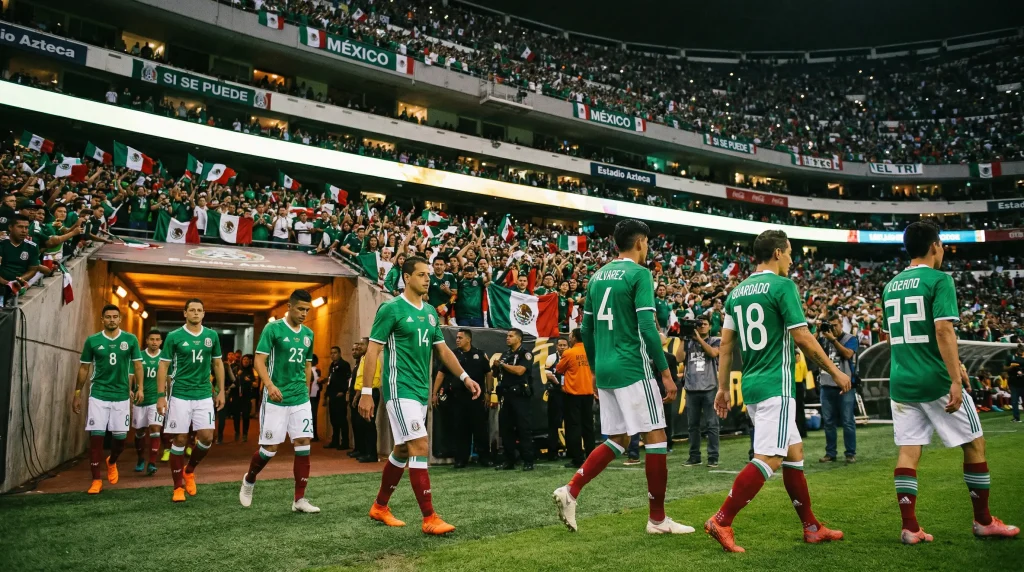
Table of Contents
June 11, 2026. Estadio Azteca, Mexico City. Eighty thousand voices singing in unison as El Tri takes the pitch for the tournament’s opening match against South Africa. This scene — one of football’s most iconic venues hosting the World Cup’s inaugural fixture — represents the culmination of Mexico’s co-hosting vision. The nation that has given football the Azteca, the Wave, and generations of passionate supporters will launch the 2026 World Cup from their cathedral of the sport. For the millions watching from Canadian cities with significant Mexican communities, this moment carries cultural weight that transcends the match itself.
Mexico enters the 2026 World Cup carrying the burden of history that no other co-host nation shares. Since 1994, El Tri has exited every World Cup at the Round of 16 — seven consecutive tournaments producing identical disappointment that Mexicans call “el quinto partido,” the fifth game they cannot win. This psychological barrier has survived coaching changes, generational transitions, and tactical evolutions. The 2026 tournament, with thirteen matches on Mexican soil including the opening fixture, presents either the opportunity to finally break through or the risk of failing at home, which would compound decades of frustration.
El Tri’s Squad — Familiar Faces, New Expectations
The Mexican squad approaching 2026 features a blend of European-based talent and Liga MX stalwarts that characterizes their selection patterns. Unlike nations who build squads almost exclusively from top European leagues, Mexico maintains pathways for domestic league performers alongside players who have succeeded abroad. This dual-track approach provides depth and local knowledge while occasionally raising questions about whether the best available players earn selection.
Santiago Giménez carries Mexican goalscoring hopes after his emergence at Feyenoord transformed his trajectory from MLS prospect to Eredivisie star. His combination of physical presence and intelligent movement creates a modern striker profile that previous Mexican forwards lacked. Giménez’s European development addressed the historical Mexican weakness at centre-forward — for decades, El Tri struggled to produce strikers who could compete against elite central defenders. His 2026 World Cup performance will likely determine whether Mexico can finally translate group-stage competence into knockout-round success.
Edson Álvarez provides midfield foundation through defensive positioning and ball recovery that allows more creative teammates to focus on attacking contributions. His experience at Ajax and subsequent moves has exposed him to European tactical demands that Mexican domestic league competition cannot replicate. Álvarez’s leadership role extends beyond tactical contribution — he represents the bridge between Mexican football tradition and modern European standards that the national team requires.
The attacking positions around Giménez feature players whose club situations fluctuate between secure and uncertain. Hirving Lozano’s pace and dribbling ability create wide threat when deployed effectively, though his club career has featured more moves than sustained success at any single destination. Diego Lainez’s technical ability suggests creative dimensions, though his playing time at various clubs has not matched the promise his youth career generated. These attackers provide variety without the consistent production that eliminates lineup uncertainty.
Defensively, Mexico relies on experienced performers whose club careers have produced professional reliability rather than elite excellence. César Montes and Jorge Sánchez provide options across the back line, with tactical flexibility allowing formation adjustments based on opponent analysis. The goalkeeping situation features competition between several capable options without clear hierarchy — a depth advantage that creates selection headaches alongside quality assurance.
The fullback positions represent ongoing Mexican development priorities. The traditional Liga MX pathway has produced defenders who understand tactical responsibilities without necessarily possessing the athleticism that modern fullback roles demand. European-based alternatives offer different profiles — more comfortable in attacking transitions but sometimes vulnerable defensively. Finding the right balance at these positions affects Mexican ability to compete against opponents whose wide play creates overloads that fullbacks must handle.
The midfield depth beyond Álvarez includes options whose roles depend on tactical system selection. More creative profiles suit possession-oriented approaches, while more defensive alternatives support pragmatic tournament tactics. This flexibility allows coaching staff to adjust based on opponent analysis, though it also creates uncertainty about Mexican identity that consistent selection might resolve. Whether Mexico plays as possession-dominant side or counter-attacking opportunists shapes betting approach for their fixtures.
The coaching transition since the 2022 World Cup has produced tactical uncertainty that betting markets must incorporate. The approach that new management implements — whether continuing traditional Mexican possession-oriented football or adapting toward more pragmatic tournament tactics — shapes how El Tri performs against different opponent profiles. This uncertainty creates betting variance beyond pure squad assessment.
Group A — South Korea, South Africa, Czechia
Mexico’s Group A draw provides the opening-match honor alongside opponents who present competitive challenges without featuring traditional powers. South Korea, South Africa, and Czechia each bring different characteristics that test Mexican capability across distinct tactical matchups.
South Korea represents the group’s primary threat to Mexican group-winner aspirations. The Koreans’ 2022 World Cup Round of 16 appearance — achieved through a dramatic final-matchday victory over Portugal — demonstrated tournament capability that their FIFA ranking sometimes understates. Son Heung-min’s individual quality creates attacking threat that Mexican defenders must respect, while Korean midfield organization and pressing intensity can disrupt possession-oriented opponents. The Mexico vs South Korea fixture likely determines group positioning, with both nations favored over South Africa and Czechia.
South Africa’s return to World Cup competition brings nostalgic resonance — their 2010 hosting represents the only African World Cup to date — but their current squad lacks the firepower to threaten Mexican qualification. The opening-match setting at Azteca creates additional Mexican advantage: South African players adjusting to altitude and atmosphere while Mexican players compete in conditions as familiar as club football. For betting purposes, this match creates margin markets where Mexico should win comfortably against opponents whose defensive approach cannot contain sustained Mexican attacking pressure.
Czechia brings European defensive organization that can frustrate technically superior opponents. Their qualification through European playoffs demonstrated resilience that knockout-format competition rewards. The Czechs will not concede easily, creating matches where Mexican patience determines outcome more than individual brilliance. Total goals markets may favor unders in Czechia fixtures regardless of opponent, their pragmatic approach prioritizing clean sheets over attacking adventure.
The group scheduling places Mexico’s opening match first (June 11 vs South Africa), followed by South Korea and Czechia fixtures that determine final positioning. The opening-match pressure — performing before home crowd with global attention on tournament’s first fixture — creates psychological challenge that previous Mexican squads have handled inconsistently. Victory against South Africa seems probable, but the margin and manner of that victory affects momentum entering more competitive group fixtures.
Mexico’s Betting Odds and Tournament Ceiling
Mexican tournament winner odds between 35.00 and 50.00 position them as dark horse rather than genuine contender. This pricing incorporates the historical Round of 16 ceiling that seven consecutive tournaments have established. Whether this ceiling represents structural limitation or statistical variance shapes fundamental betting assessment.
The case for Mexico at these odds emphasizes home-continent advantage that previous tournaments could not provide. Thirteen matches on Mexican soil, including multiple knockout-round venues, creates atmosphere and logistical advantages that no visiting team can replicate. Mexican crowd energy at Azteca produces intensity that affects opponent performance in measurable ways. If bracket paths allow Mexico to play knockout matches at Mexican venues, the home advantage could compensate for talent gaps against superior opposition.
The case against Mexico at these odds notes that talent comparison still favors European and South American elite regardless of venue advantage. Mexican squad quality does not match France, England, Argentina, or Brazil — and tournament football eventually produces matchups where these discrepancies determine outcomes. The psychological weight of “el quinto partido” may actually intensify rather than disappear when playing on home soil, creating additional pressure rather than advantage.
My assessment positions Mexican probability near their market-implied odds, making them neither clear value nor dramatic overpricing. The prices around 35.00 to 50.00 reflect appropriate skepticism about their ability to break historical patterns while acknowledging the home-continent context that distinguishes 2026 from previous tournaments. For tournament betting, Mexico represents moderate-variance position: if home advantage proves decisive, their odds provide meaningful return, but structural limitations may persist regardless of venue.
Group A winner odds around 1.80 capture expected Mexican group dominance while acknowledging South Korean competitive threat. Mexico should qualify from this group, likely finishing first, and this market provides cleaner exposure than tournament outrights requiring five additional victories. The pricing reflects appropriate uncertainty about the South Korea fixture that could determine group positioning.
Progression markets offer tiered exposure based on bracket advancement expectations. Mexico to reach Round of 16 at prices around 1.25 requires merely group qualification — achievable given their Group A draw and home advantage. Mexico to reach quarter-finals around 3.00 adds the Round of 16 hurdle that has historically defeated them. These markets allow bettors to calibrate exposure based on confidence level in Mexican ability to finally break through the fifth-game barrier.
The head-to-head markets between Mexico and other CONCACAF nations provide regional context. Mexico vs USA prices, Mexico vs Canada positioning, and similar continental comparisons attract betting interest from those following North American football dynamics. Mexican public money influences these markets significantly, creating potential value when analytical assessment differs from emotional investment. The rivalry dynamics within CONCACAF add betting dimensions that purely European-focused analysis might miss.
The Fifth Game Curse — Can Mexico Finally Break Through
Understanding Mexican World Cup psychology requires examining the pattern that has defined their tournament experience since 1994. Seven consecutive Round of 16 exits — against Germany, Argentina, Netherlands, Netherlands again, Brazil, and others — have created national trauma that influences everything from media coverage to player interviews. The “quinto partido” narrative pervades Mexican football discourse to degree that foreign observers sometimes underestimate.
The 1994 exit came against Bulgaria in penalties. 1998 featured a Germany defeat. 2002 brought a 2-0 loss to the United States that still stings. 2006 produced extra-time defeat to Argentina. 2010 and 2014 saw Netherlands victories, the latter featuring no-era-penal controversy that Mexican supporters have not forgotten. 2018 brought Brazil demolition, and 2022 produced the embarrassment of not even reaching the Round of 16 for the first time since 1978. This history creates psychological baggage that no tactical adjustment can fully address.
For 2026, Mexican players will enter knockout rounds knowing that national expectation demands they break this pattern — on home soil, with home crowds, against opponents who may not match Mexico’s historical Round of 16 antagonists in quality. The pressure could liberate or paralyze. Mexican sports psychology has historically struggled with expectation management, producing either overwhelming confidence or crushing self-doubt without consistent ability to find productive middle ground.
Betting markets cannot fully price psychological factors that operate beneath tactical and talent analysis. The possibility that Mexican players rise to the moment — finally breaking through when it matters most — exists alongside the possibility that accumulated pressure produces familiar failure. This uncertainty creates betting variance that pure squad comparison does not capture, making Mexican positions inherently speculative regardless of apparent value.
The 2026 context differs from previous tournaments in one crucial respect: Mexican players will face knockout opponents at venues where the crowd overwhelmingly supports El Tri. Previous Round of 16 exits occurred in neutral or opponent-favorable venues where Mexican supporters, though numerous, could not dominate atmosphere. If bracket paths allow Mexico to play their Round of 16 match at a Mexican venue — or even American venues with large Mexican-American attendance — the pressure equation changes in ways that could finally produce different results.
Mexico Picks — Where We See Value
My analysis of Mexico’s World Cup 2026 betting landscape identifies several positions offering value for Canadian sportsbook users:
Mexico vs South Africa over 2.5 total goals at prices around 1.70 captures expected Mexican dominance in the opening fixture. The Azteca atmosphere, home-crowd energy, and opening-match significance create environment where Mexican attacking players should express themselves freely. South Africa’s defensive limitations against sustained pressure mean Mexican goals are probable, while their own attacking ambitions — necessary to compete for group advancement — create additional goal probability.
Giménez to score 2+ tournament goals at prices around 2.50 offers value based on his expected involvement across Mexico’s probable four-to-six matches. As primary striker, Giménez receives the chances that Mexican buildup creates, and his finishing ability at Feyenoord demonstrates conversion rates that justify this threshold. The group-stage fixtures against South Africa and Czechia particularly suit his skill set, providing goal opportunities before knockout-round intensity arrives.
Mexico to win Group A at approximately 1.80 provides group-level exposure that captures expected dominance without knockout-round uncertainty. The South Korea fixture represents primary obstacle, but Mexican talent and home advantage create probability that this price undervalues. Group winner positioning affects bracket path favorably, adding value beyond the immediate market return.
Mexico clean sheet vs Czechia at prices around 2.40 offers value based on expected tactical approaches. Czech defensive orientation limits their attacking threat, while Mexican defensive organization should handle limited Czech attacking variety. The probability of 1-0 or 2-0 Mexican victory exceeds what this clean sheet price implies, creating exploitable inefficiency.
For longer-term positions, Mexico to reach quarter-finals at prices around 3.00 captures the breakthrough narrative without requiring the tournament title. If Mexico finally wins their Round of 16 match, quarter-final qualification follows automatically. This market construction captures the “el quinto partido” breakthrough potential while avoiding the subsequent uncertainty of quarter-final opposition quality.
Mexico total tournament goals over 6.5 at prices around 1.85 provides team-level exposure across expected four-to-five matches. With Giménez leading the attack and multiple supporting scorers available, Mexican collective goalscoring should clear this threshold given favorable group-stage matchups against South Africa and Czechia. The opening-match environment particularly suits Mexican attacking expression, potentially producing early goal accumulation that establishes this position favorably.
Álvarez to receive a booking during tournament at prices around 2.00 offers value based on his playing style and expected minutes. His defensive midfield responsibilities require tactical fouls that accumulate yellow cards across four-to-six potential matches. The probability of at least one booking exceeds what this price implies, particularly in competitive fixtures against South Korea or knockout opponents where preventing counter-attacks justifies card risk. His aggressive ball-winning style makes card accumulation likely across tournament duration.
Mexico first tournament goal scorer (vs South Africa) market offers speculative opportunity in the opening fixture. The player who scores the tournament’s first goal — assuming Mexico scores before South Africa in the opening match — receives attention that transcends the goal’s tactical significance. Giménez as primary striker carries obvious probability, but wide players and set-piece threats provide alternative options at longer prices that could represent value.
