
USA at the 2026 World Cup — The Hosts, the Hype, and Group D
 Available in US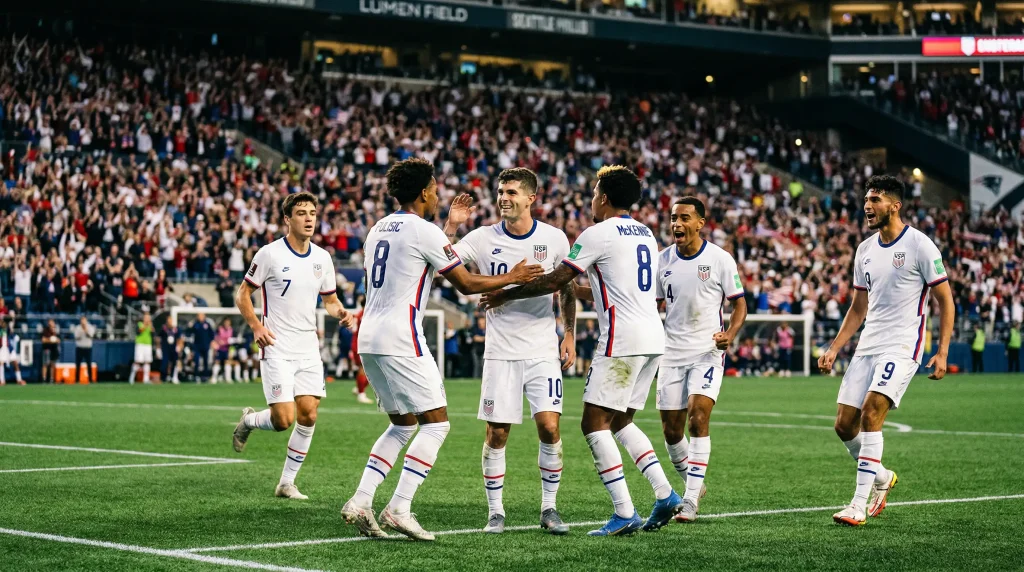
Table of Contents
Our neighbours to the south are co-hosting the World Cup — and from a Canadian perspective, that creates the tournament’s most fascinating subplot. The United States enters 2026 with expectations that dwarf anything previous American squads have carried. Eleven stadiums across America will host 78 of the tournament’s 104 matches. The opening fixture belongs to Mexico at Azteca, and the final takes place at MetLife Stadium in New Jersey, but the bulk of this World Cup unfolds on American soil, in American time zones, before American crowds. For Canadian bettors, understanding the USMNT means understanding our closest rival and most frequent opponent.
American soccer has invested billions toward this moment. Major League Soccer has expanded into a league that attracts designated players from Europe’s top competitions. Youth development academies have produced a generation of players who compete at elite European clubs. The infrastructure — stadiums, training facilities, media coverage — now rivals traditional football nations. Whether this investment translates into World Cup success represents the defining question for American soccer’s credibility on the global stage. The betting markets price USA between 12.00 and 16.00 for tournament victory, reflecting genuine contention without quite reaching favourite status.
Pulisic, McKennie, and a Squad Built for This Moment
Christian Pulisic carries the weight of American soccer expectations with a determination that alternates between inspiring and burdensome. His journey from Hershey, Pennsylvania, to Borussia Dortmund to Chelsea to AC Milan charts American football’s growing integration with European excellence. At 27 during the 2026 World Cup, Pulisic enters his physical prime having accumulated European league and Champions League experience that previous American stars lacked. His ability to create chances in tight spaces — through dribbling, through intelligent movement, through final-ball delivery — provides the individual quality that tournament football regularly rewards.
Weston McKennie offers the midfield engine that connects American defence to attack. His Juventus career, despite the club’s mixed fortunes, has exposed him to Italian tactical education that emphasizes positioning and discipline over raw athleticism. McKennie’s box-to-box energy covers defensive responsibilities while supporting attacking sequences, a dual contribution that allows more creative teammates to focus on chance creation. His aerial presence at set pieces adds goal threat from midfield, diversifying American attacking routes beyond their primary wide players.
Gio Reyna’s talent has always been undeniable — his technical ability at Borussia Dortmund demonstrated skills that matched any American prospect in history. Whether his body cooperates remains the uncertainty. Injury interruptions have prevented Reyna from establishing consistent form, creating situations where American supporters simultaneously recognize his ceiling and doubt his reliability. If Reyna arrives at the 2026 World Cup fully fit, the USMNT possesses a creative weapon that transforms their tactical possibilities. If injuries persist, they must construct their attacking approach around Pulisic’s shoulders with less supporting quality.
The defensive foundation features Sergiño Dest’s attacking overlaps from right-back, though his defensive reliability generates ongoing debate. Antonee Robinson provides left-back athleticism that Premier League football has refined. The centre-back positions remain American football’s most significant concern — no American defender has established themselves at elite European level with the consistency their attacking counterparts have achieved. Tim Ream’s experience and Miles Robinson’s physical presence offer options, but tournament football exposes defensive limitations that league play can obscure.
Matt Turner’s goalkeeping brings Premier League experience, though his playing time at Arsenal has fluctuated. The American goalkeeping tradition — extending from Kasey Keller through Tim Howard to Brad Guzan — suggests shot-stopping reliability that tournament football demands. Whether Turner represents continuation of that tradition or departure from it shapes American defensive expectations.
The striking position features various options without clear hierarchy. Josh Sargent’s finishing ability, Folarin Balogun’s pace and movement, and Ricardo Pepi’s positional intelligence all offer different profiles that tactical matchups might favor. This variety provides manager flexibility while creating selection uncertainty that betting markets must incorporate.
Tyler Adams brings defensive midfield presence when healthy, though injury concerns have plagued his career development. His Leeds United and subsequent moves have demonstrated Premier League capability without establishing consistent availability. If Adams enters the 2026 World Cup fully fit, American midfield balance improves significantly. If injury limitations persist, McKennie must shoulder greater defensive responsibility that could limit his attacking contributions.
Yunus Musah’s Valencia development created excitement about American midfield depth, his technical ability suggesting creative dimensions that previous generations lacked. Whether Musah earns regular starting role depends on tactical preferences — his skillset differs from Adams’ defensive orientation and McKennie’s box-to-box energy. The versatility these three provide allows formation adjustments that suit specific opponents, though it also creates selection decisions that inevitably disappoint excluded players.
Brenden Aaronson provides energy and pressing intensity from advanced positions that suit certain tactical approaches. His Leeds United experience — including Premier League survival campaigns — demonstrated ability to compete at high level despite limited technical ceiling compared to teammates. Aaronson’s work rate creates defensive contributions from forward positions that more talented but less industrious alternatives cannot match.
Group D — Paraguay, Australia, Turkey
The United States drew Group D alongside Paraguay, Australia, and Turkey — a group that presents competitive challenges without featuring traditional powers. Each opponent brings specific characteristics that test different aspects of American capability, and the home-nation pressure makes every result carry weight beyond mere qualification mathematics.
Paraguay returns to World Cup competition after missing the 2022 tournament, their South American qualifying campaign demonstrating resilience that CONMEBOL’s brutal qualification format demands. Paraguayan football historically emphasizes defensive organization and physical commitment over technical elegance — qualities that tournament football regularly rewards against more talented but less disciplined opponents. The USA vs Paraguay fixture represents the group’s tactical battle: American technical superiority versus Paraguayan defensive structure and counter-attacking efficiency.
Australia brings familiar CONCACAF-adjacent competition that American players understand from Gold Cup and friendly encounters. The Socceroos’ 2022 World Cup run — reaching the Round of 16 before falling to Argentina — demonstrated tournament capability that their FIFA ranking might understate. Australian athleticism and direct approach create different challenges than Paraguay’s defensive orientation, requiring American tactical adjustment across consecutive group fixtures. The Australia match also carries Commonwealth connection for Canadian observers — two nations whose football programs developed through similar pathways competing on American soil.
Turkey combines European technical quality with physical commitment that makes them dangerous opponents in any format. Their squad features players from top European leagues — Juventus, Inter Milan, various Premier League clubs — whose individual quality matches American counterparts. The Turkey fixture likely determines group positioning: victory probably secures first place for either side, while defeat creates Round of 32 placement uncertainty that affects bracket path difficulty.
The American home advantage pervades every Group D fixture. Crowds at whichever venues host these matches will overwhelmingly support the USMNT, creating atmosphere that approximates competitive advantage typically reserved for club football. How visiting teams handle hostile American environments — crowds that understand football’s rhythms despite stereotypes about American soccer knowledge — affects match outcomes in ways pure tactical analysis cannot capture.
The scheduling of Group D matches affects preparation and recovery differently for home nation versus visitors. American players can train at familiar facilities, sleep in comfortable environments, and minimize travel disruption that South American and European opponents cannot avoid. These logistical advantages accumulate across three group matches, creating physical freshness differential that manifests in second-half performance when tired legs affect technical execution.
Weather conditions at American venues during June add variable that primarily benefits home nation familiarity. Summer heat in southern venues, altitude in certain locations, and climate variation across eleven potential stadiums create conditions that American players understand from domestic competition. Visiting teams must adapt to environmental factors alongside tactical challenges, a dual burden that tournament football’s compressed schedule makes difficult to manage.
USA’s Betting Odds — Home Advantage on Overdrive
American tournament winner odds between 12.00 and 16.00 reflect genuine contention balanced against historical limitations. The USA has reached World Cup quarter-finals once in modern era (2002, co-hosted with South Korea and Japan), but never the semi-finals. Their deepest tournament runs have coincided with home-continent hosting — a pattern that 2026’s American-heavy venue distribution might repeat. Whether home advantage can elevate this squad beyond historical ceiling shapes the fundamental betting question.
The case for USA at these odds emphasizes unprecedented convergence of factors. The squad features more European-based players than any previous American team. The home-nation energy across eleven American venues creates atmosphere advantages that no visiting team can replicate. The generation that developed through improved youth academies reaches competitive maturity precisely as the World Cup arrives on home soil. If everything aligns — and American football has specifically planned for this alignment — this represents the optimal moment for breakthrough performance.
The case against USA at these odds notes defensive vulnerabilities that elite opponents will exploit, the pressure of expectation that has historically weighed on American athletes in individual sports, and the reality that tournament football requires seven consecutive victories that even talented squads rarely achieve. American sports culture produces athletes who thrive under pressure, but it also produces athletes who crack under pressure — and World Cup knockout rounds create pressure that domestic leagues cannot simulate.
My assessment positions American probability slightly above their market-implied odds, making them modest value for tournament consideration. The home advantage factor receives insufficient weight in pricing that evaluates squads primarily through squad comparison. American crowds, American time zones, American media attention, and American athlete familiarity with these specific venues combine into advantages that visiting teams cannot neutralize regardless of superior talent.
Group D winner odds around 1.50 capture expected American group dominance without requiring knockout-round progression. The USA should navigate this group successfully, likely finishing first, and this market provides cleaner exposure than tournament outrights that require five additional victories.
Progression markets offer tiered exposure based on bracket advancement expectations. USA to reach quarter-finals at prices around 1.75 requires merely two knockout victories after group qualification. USA to reach semi-finals around 3.25 adds the quarter-final hurdle where elite opposition typically appears. These markets allow calibrated exposure that captures home-advantage benefits through preliminary rounds while allowing for the possibility that genuine elite sides eliminate American hopes when bracket paths converge.
The head-to-head markets between USA and traditional powers create speculative opportunities. USA vs England prices, USA vs Germany prices, and USA vs Argentina prices all attract betting interest despite requiring specific bracket outcomes. American public money pushes these lines toward American-favorable territory, potentially creating value on opposition positions when emotional betting overrides analytical assessment. The historical baggage these matchups carry — American memories of 1950’s England upset, more recent tournament encounters — influences pricing beyond current squad comparison.
Regional markets comparing USA to other CONCACAF nations provide additional angles. USA vs Mexico rivalry lines, USA to finish above Canada in overall tournament progression, and similar CONCACAF-specific propositions capture regional dynamics that global tournament markets do not isolate. These niche markets sometimes offer better value than broader tournament positioning because pricing reflects smaller betting pools with less sharp-money correction.
Canada vs USA — The North American Rivalry at the World Cup
The rivalry between Canadian and American men’s national teams has intensified dramatically since 2020. What was once predictable American dominance has become genuinely competitive fixture that either side can win. Canada’s 2022 World Cup qualification — their first since 1986 — coincided with victories over the USA that announced CanMNT as legitimate rival rather than regional pushover. The 2026 World Cup, with both nations co-hosting, elevates this rivalry to global stage that previous iterations never reached.
The group stage draw places Canada in Group B and USA in Group D, eliminating direct confrontation until knockout rounds. If both nations advance — the expected outcome given their hosting advantages — bracket path determines whether rivalry match occurs. The possible scenarios include Round of 32 crossover, Round of 16 meeting, or later-stage encounter that would become the tournament’s defining narrative for both countries.
From Canadian betting perspective, the USA analysis matters because American results affect CanMNT bracket positioning. If USA tops Group D as expected, the teams they might face in subsequent rounds differ from scenarios where USA finishes second or (improbably) fails to advance. Tracking American performance provides information relevant to Canadian betting positions even when the nations are not directly competing.
The cross-border viewing dynamics create unique atmosphere for Canadian observers following American matches. Toronto sports bars will feature split crowds when USA plays — Canadian fans hoping American struggles create favorable bracket path versus Americans living in Canada supporting their national team. This tension adds texture to viewing experience that purely neutral World Cup observation lacks.
The competitive balance between programs has shifted enough that a hypothetical Canada-USA World Cup match would not carry predetermined outcome. American superiority in depth and resources no longer guarantees victory against Canadian quality that includes Alphonso Davies, Jonathan David, and supporting cast competitive with any CONCACAF rival. The possibility of Canadian victory in such a fixture — unthinkable a decade ago — now represents realistic scenario that betting markets would price as competitive.
The bilateral relationship between nations adds stakes that purely football considerations cannot capture. Canadian national identity often defines itself partly through distinction from American dominance, and World Cup football provides arena for that distinction to manifest. American victory in a head-to-head match would feel like cultural defeat for Canadian supporters; Canadian victory would produce celebration extending well beyond football-specific communities.
The media narratives surrounding potential Canada-USA match would emphasize asymmetric expectations. American coverage would frame defeat to Canada as embarrassment; Canadian coverage would frame victory as achievement. This framing imbalance creates pressure differential that could affect match psychology — American players playing not to lose versus Canadian players playing with freedom of underdogs. Betting markets historically undervalue underdog mentality in such scenarios, potentially creating value on Canadian positions if the matchup occurs.
For Canadian bettors, monitoring American betting lines provides insight into market sentiment that affects related positions. American public money pushes USMNT lines in predictable directions, creating contrarian opportunities when analytical assessment differs from emotional investment. The sheer volume of American betting activity on their national team creates market movements that smaller Canadian markets do not produce, allowing Canadian bettors to exploit inefficiencies that American market dynamics reveal.
USA Betting Value — Props and Specials
My analysis of USA’s World Cup 2026 betting landscape identifies several positions offering value for Canadian sportsbook users:
Pulisic to score 4+ tournament goals at prices around 4.50 captures his expected involvement across USA’s probable deep bracket run. If USA reaches quarter-finals or beyond, Pulisic playing five or six matches creates opportunities for this threshold given his attacking role and set-piece involvement. His penalty-taking responsibilities add goal probability beyond open-play chances alone, making this accumulator achievable given expected American match volume.
USA to keep clean sheet vs Paraguay at prices around 2.10 provides value based on expected tactical approaches. Paraguay’s priority will be defensive organization rather than attacking adventure, creating match dynamics where goals become scarce for both sides. American defensive vulnerabilities matter less against opponents who create minimal attacking pressure, making clean sheet probability higher than general American defensive assessment suggests.
USA vs Turkey over 2.5 total goals at approximately 1.85 reflects likely open tactical approaches from both sides. Neither team possesses the defensive solidity to shut down opposition attacking quality, and both feature attackers capable of punishing defensive lapses. The competitive stakes — likely determining group positioning — create urgency that promotes attacking intent rather than conservative protection.
McKennie to score during group stage at prices around 3.50 offers value based on his aerial presence at set pieces. American set-piece delivery quality combined with McKennie’s timing and physical presence creates goal probability across three group matches. His late runs into the box during open play add scoring opportunities that pure defensive midfielders do not possess.
USA total tournament goals over 9.5 at prices around 2.00 provides team-level exposure across expected deep tournament run. With multiple attacking threats and favorable group-stage matchups, USA’s collective goalscoring should clear this threshold across four-to-six matches. The home-crowd energy that typically increases attacking output adds dimension beyond pure squad assessment.
For longer-term positions, USA to reach semi-finals at prices around 3.25 captures expected home-nation bracket progression without requiring final appearance. The combination of legitimate squad quality, unprecedented home advantage, and favorable bracket path from Group D creates semi-final probability that this price undervalues. This market construction acknowledges American ceiling while allowing for the possibility that semi-final opposition proves too strong for breakthrough.
USA top CONCACAF finisher at prices around 1.60 provides regional dominance exposure that bypasses global tournament uncertainty. Against Mexico and Canada as primary competition, USA’s squad depth and home advantage create strong probability of advancing further than regional rivals. This market captures expected American superiority within their confederation without requiring them to overcome European or South American elite — a more achievable outcome than tournament victory or even final appearance.
Reyna to score or assist during tournament at prices around 2.25 offers value contingent on his fitness availability. If Reyna plays significant minutes across USA’s expected four-to-six tournament matches, his creative quality makes goal involvement highly probable. The injury uncertainty that keeps this price elevated creates value for bettors willing to accept the risk that Reyna’s body does not cooperate with his talent level. His ceiling remains among the highest of any American player, making the reward proportionate to the risk assumed.
