
France at the 2026 World Cup — Odds, Squad, and Group I Breakdown
 Available in US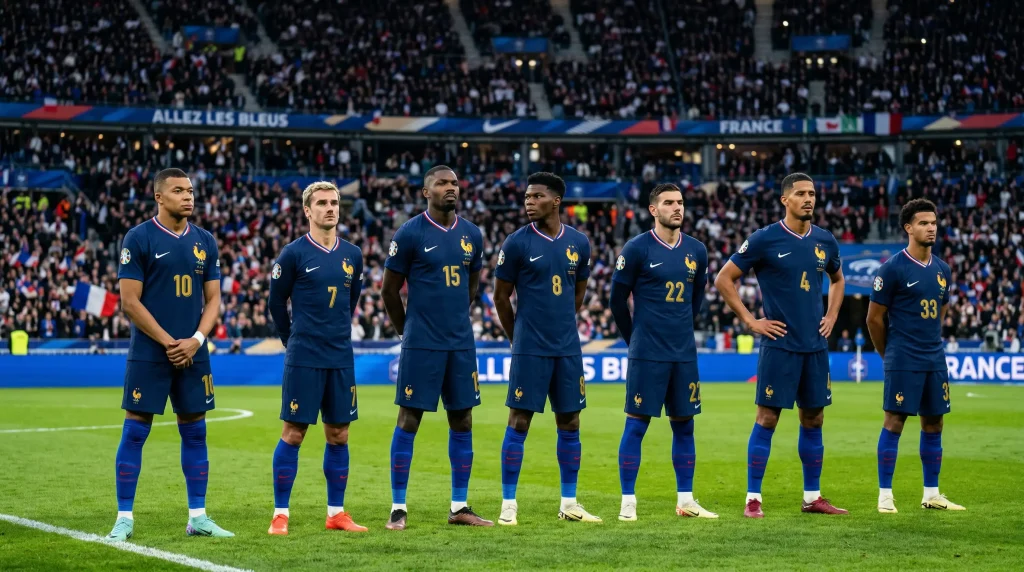
Table of Contents
At a bar in Montréal’s Plateau neighborhood last fall, I watched Les Bleus dismantle Belgium in a Nations League fixture while the room around me erupted in French — not the continental French of Paris, but the distinct Québécois French of Canadian francophones who had adopted France’s national team as their own. That scene crystallizes something important for this analysis: France at the 2026 World Cup is not merely a European contender visiting North America, but a cultural phenomenon with direct connection to millions of Canadians who share linguistic and emotional bonds with La Métropole.
The French national team enters the 2026 tournament as tournament favourites or co-favourites at most sportsbooks, with odds typically ranging between 5.50 and 7.00. This pricing reflects reality: France has reached the last two World Cup finals, won in 2018, and possesses the deepest talent pool of any European nation. Their combination of athletic excellence, tactical sophistication, and tournament experience creates a profile that betting markets struggle to look past. Whether that profile justifies the shortest odds in many markets requires examination of factors both obvious and subtle.
Mbappé, Tchouaméni, and France’s Generational Talent
Kylian Mbappé has transcended the usual trajectory of football stardom to become the most recognizable athlete in the sport not named Messi or Ronaldo. His transfer to Real Madrid — completed in summer 2024 after years of speculation — placed him at the institution that demands and develops elite-level performance. At the 2026 World Cup, Mbappé will be 27 years old: past the explosive youth that produced his 2018 breakthrough, but squarely in the physical prime that should maximize his abilities.
What separates Mbappé from other world-class attackers is the combination of elite speed with elite decision-making. Fast wingers are common. Wingers who can beat defenders in tight spaces with dribbling rather than pace are common. Wingers who possess both, plus the composure to make correct choices under maximum pressure, are extraordinarily rare. Mbappé’s goal in the 2022 World Cup final — a hat-trick that nearly salvaged what seemed a lost cause against Argentina — demonstrated that his biggest performances arrive on the biggest stages. For anytime goalscorer markets throughout France’s World Cup campaign, Mbappé represents both the safest and most efficient option.
Aurélien Tchouaméni provides the midfield foundation upon which France’s attacking talents operate. His defensive positioning eliminates space that opponents would otherwise exploit, and his passing range allows France to bypass pressing schemes that trap lesser sides in their own third. At Real Madrid alongside Mbappé, Tchouaméni has adapted to the expectations that come with representing the world’s most decorated club. That experience — the scrutiny, the pressure, the demand for perfection — prepares players for World Cup intensity better than any alternative pathway.
The defensive nucleus featuring William Saliba, Dayot Upamecano, and Ibrahima Konaté offers manager Didier Deschamps multiple configurations depending on opponent characteristics. Saliba’s maturation at Arsenal has elevated him to first-choice status alongside whichever partner suits specific matchups. The fullback positions feature Theo Hernández raiding forward from left-back while Jules Koundé provides more conservative balance on the right. In goal, Mike Maignan has established himself as Hugo Lloris’s successor, bringing reflexes and commanding presence that match his predecessor’s standards.
The supporting cast extends deep enough that France can compete at full strength despite individual absences. Antoine Griezmann, though no longer the dynamic force of his prime, contributes tactical intelligence and work rate that improve collective function. Randal Kolo Muani provides centre-forward presence when tactical situations demand physical reference point. Ousmane Dembélé’s pace stretches defences horizontally, complementing Mbappé’s central and left-side threat. This depth means France can rotate without significant quality dropoff — a crucial advantage across a tournament that demands seven matches to win.
The emerging generation includes talents who may announce themselves at this World Cup just as Mbappé did in 2018. Bradley Barcola has developed rapidly at Paris Saint-Germain, offering dynamic wing play that provides genuine rotation option for Mbappé or Dembélé. Warren Zaïre-Emery represents the midfield future, though his minutes in a tournament squad remain uncertain given established competition. Eduardo Camavinga’s versatility allows Deschamps to adjust formation without sacrificing quality — he can deputize in midfield or cover left-back responsibilities. This generational overlap between proven veterans and ambitious youngsters creates healthy internal competition that typically sharpens tournament performance.
Group I — Senegal, Iraq, Norway
The draw placed France in Group I alongside Senegal, Iraq, and Norway — a group that combines genuine threat, debutant uncertainty, and European familiarity. Navigating this group should prove straightforward for French quality, but each opponent presents specific challenges that match betting must address.
Senegal represents the group’s clear danger. Their 2022 World Cup campaign, though ended by England in the Round of 16, demonstrated African football’s continued ascent toward competitive parity with traditional powers. Sadio Mané’s presence (if fit — injury concerns have plagued his recent seasons) provides individual quality capable of punishing defensive lapses. The Senegalese midfield features organization and athleticism that can disrupt France’s preferred rhythms, while their defensive structure proved resilient against higher-ranked opponents throughout 2022. I expect this match to produce the group’s most competitive betting lines, with Senegal +1.0 Asian handicap potentially offering value if markets overreact to France’s favourite status.
Iraq returns to the World Cup for the first time since 1986, their participation representing one of the tournament’s most compelling underdog stories. The Iraqi squad earned their place through Asian qualification, defeating established regional powers along the way. Their defensive organization typically exceeds what casual observation of their FIFA ranking might suggest, and the emotional significance of World Cup return for Iraqi football could produce performances beyond baseline expectations. For betting purposes, Iraq represents primarily a vehicle for French margin markets — heavy French victories seem probable, with the question being degree rather than outcome.
Norway brings familiar European competition to Group I, though their tournament pedigree remains limited despite individual talents. Erling Haaland’s goalscoring ability creates obvious threat that France must respect, and the Norwegian midfield featuring Martin Ødegaard possesses technical quality that can create problems in transition. However, Norway’s collective tournament performance has historically lagged their individual quality — a pattern that suggests France should handle this fixture comfortably despite Haaland’s presence. Total goals markets may favour overs if both teams express their attacking tendencies rather than neutralizing each other defensively.
France’s path through Group I seems predetermined toward advancement, but the margin of that advancement affects knockout-round seeding. Topping the group produces more favorable Round of 32 placement than finishing second, creating incentive for France to pursue maximum points rather than merely secure qualification. This competitive motivation means France likely deploys strong lineups throughout the group stage rather than resting key players for knockout rounds.
France’s Betting Odds — Always the Contender
France’s tournament winner odds around 5.50 to 7.00 position them as genuine co-favourites alongside England and ahead of Argentina. This pricing implies roughly 15-18% probability of lifting the trophy — premium pricing that reflects their sustained excellence across recent tournament cycles. Whether that pricing offers value depends on how you assess several competing factors.
The case for France at these odds rests on their tournament résumé. Reaching consecutive World Cup finals requires consistent excellence across multiple high-stakes matches, and France has demonstrated exactly that. Their knockout-round record since 2018 — advancing past Belgium, Uruguay, Argentina (in 2018), and Morocco before the 2022 final against Argentina — features no fluky results or fortunate draws. They have earned their bracket progression through quality rather than circumstance.
The case against France at these odds involves squad age and potential motivation concerns. Several key players, including Griezmann and Giroud (if selected), carry accumulated tournament mileage that may affect late-tournament performance. The psychological challenge of returning to a World Cup final after the agonizing 2022 defeat creates uncertainty — will the experience fuel France or haunt them if similar pressure situations arise? Additionally, France’s Euros 2024 campaign, though reaching the semi-finals, featured less convincing performances than their World Cup pedigree might suggest.
My assessment places France’s true probability slightly below their market-implied odds, primarily because the pricing assumes seamless squad transition despite generational turnover at key positions. The prices are not dramatically wrong — France genuinely ranks among the tournament’s elite contenders — but the edge available from backing France outright appears minimal. Value exists in their match-level betting markets rather than tournament outrights.
Group I winner at prices around 1.15 reflects France’s overwhelming advantage and offers no practical edge. France to qualify at prices near 1.05 similarly represents efficient pricing with no exploitable gap. The interesting angles emerge in specific match markets and progression odds beyond the group stage, where individual matchup factors create more variance than the overall tournament price incorporates.
Back-to-Back Dreams — France’s World Cup Pedigree
France’s World Cup history features peaks and valleys that inform expectations for 2026. Their two tournament victories — 1998 on home soil and 2018 in Russia — bookend a period that includes group-stage exits in 2002 and 2010, demonstrating that French excellence requires specific conditions to manifest in tournament success.
The 2018 squad that lifted the trophy in Moscow represented the emergence of the current generation. Mbappé announced himself as global phenomenon with performances that drew comparisons to Brazilian Ronaldo. Kanté and Pogba controlled midfields. Varane and Umtiti anchored defence. That team combined youthful energy with experienced guidance from Lloris and Giroud, producing the balance that tournament football rewards. The tactical approach under Deschamps — pragmatic, flexible, defensively sound — suited knockout-round football where minimizing risk often matters more than maximizing attacking output.
The 2022 campaign extended that excellence despite squad turnover and injury disruptions. Benzema’s late withdrawal before the tournament began, Pogba’s absence, and various fitness concerns throughout the squad could have derailed French hopes. Instead, alternatives stepped forward — Giroud’s goalscoring, Griezmann’s tactical contribution, Kolo Muani’s emergence from the bench — demonstrating collective resilience that compensated for individual absences. The final against Argentina ranks among the most dramatic matches in World Cup history, and France’s near-victory despite trailing 0-2 after 79 minutes revealed a mentality that refuses surrender.
For 2026, the question becomes whether this squad can achieve what no European team has accomplished since Spain in 2010: winning back-to-back major tournaments. France won Euro 2000 after their 1998 World Cup, but that squad featured prime-era Zidane rather than transitional personnel. The current French squad must prove they can maintain excellence as certain veterans decline and younger players assume greater responsibility.
France Value Bets — Props and Specials
My analysis of France’s World Cup 2026 prospects produces the following betting recommendations for Canadian sportsbook users:
Mbappé to score 5+ tournament goals at prices around 3.50 offers value given his expected involvement and France’s probable deep bracket run. If France reaches the semi-finals or beyond, Mbappé playing seven matches creates sufficient opportunities for this threshold to clear. His penalty-taking responsibility further increases goal probability beyond open-play chances alone. The market sometimes underprices this accumulator scenario because casual bettors focus on per-match goalscoring rather than tournament totals.
France vs Senegal — under 2.5 total goals at approximately 2.10 provides value based on expected tactical approaches. Senegal’s defensive organization frustrates opponents who expect open play, while France under Deschamps often prioritizes security over spectacle against quality opposition. A 1-0 or 2-0 French victory represents the most likely outcome template. The public money tends to favor overs in matches featuring star attackers, creating inefficiency in unders pricing that sharp bettors can exploit.
France clean sheet against Iraq at prices near 1.50 captures probable defensive dominance against limited attacking threat. Iraq’s qualification journey featured defensive resilience more than attacking prowess, suggesting they will struggle to create genuine chances against France’s defensive structure. The French back line should experience minimal stress, making clean sheet probability higher than standard pricing suggests.
Griezmann to score or assist in any group match at combined price around 1.80 offers value based on his consistent tournament contribution record. Even with diminished primary role, Griezmann’s positioning and decision-making create regular involvement in French goals. Across three group matches, his participation in at least one goal carries high probability. His experience finding dangerous positions in crowded penalty areas has not declined despite his reduced explosiveness.
Tchouaméni to receive a booking during the tournament at prices around 2.25 provides value based on his playing style and expected minutes. His defensive midfield responsibilities require tactical fouls that accumulate yellow cards across seven potential matches. The probability of at least one booking exceeds what this price implies, particularly in knockout matches where preventing counter-attacks justifies card risk.
For longer-term markets, France to reach the final at prices around 3.00 provides cleaner exposure than outright tournament winner positions. The finals market requires merely reaching the decisive match, not winning it — and France’s record of reaching finals exceeds their record of winning them. This approach captures France’s expected deep run while avoiding the uncertainty of the final itself. Two consecutive finals and a semi-final appearance in the last three major tournaments demonstrate France’s bracket-stage reliability.
Deschamps’ Tournament Philosophy
Didier Deschamps has managed France since 2012, a tenure that makes him the longest-serving current manager among tournament favourites. His approach has evolved across this span — from the attacking football of the 2016 Euro finals run to the pragmatic efficiency that won the 2018 World Cup — but certain principles remain constant. Understanding these principles helps anticipate how France will approach specific matchups.
Deschamps prioritizes defensive organization above all other tactical considerations. France under his management rarely concedes multiple goals, and their knockout-round success derives partly from this defensive reliability. Even when possessing attacking talent that could justify more adventurous approaches, Deschamps maintains conservative structures that minimize risk. For bettors, this philosophy suggests unders on total goals markets when France faces quality opposition — Deschamps will not sacrifice defensive stability for attacking spectacle.
In possession, France operates through wide areas where Mbappé and supporting wingers can isolate defenders in one-on-one situations. The approach resembles Real Madrid’s direct attacking style, which makes sense given how many French players operate within that club’s tactical framework. Quick vertical progressions take priority over intricate build-up patterns, and French forwards receive license to attempt individual solutions rather than maintaining rigid positional structure. This directness produces high-variance attacking sequences: France either creates excellent chances through individual brilliance or surrenders possession through failed dribbles and misplaced final balls.
The midfield triangle configuration varies based on opponent analysis. Against compact defensive teams, Deschamps often deploys more creative profiles to unlock space. Against transitional opponents, additional defensive midfield presence protects against counter-attacks. This flexibility explains why France can compete across tactical matchups — Deschamps adapts rather than insisting on ideological consistency.
Tournament football rewards Deschamps’ approach because knockout matches penalize attacking teams who leave defensive gaps. France’s ability to secure leads and defend them creates confidence that compounds across bracket progression. Teams that must chase goals against organized French defence face low-probability scenarios, which is exactly how Deschamps designs his tactical setups.
The Montréal Connection — French Canada Meets Les Bleus
The 2026 World Cup in North America creates unique dynamics for France that other European participants will not experience. Nearly eight million Canadians claim French as their first language, concentrated primarily in Québec but present in significant communities across every Canadian province. For these French Canadians, Les Bleus represent connection to ancestral culture that transcends typical national team support.
Montréal’s World Cup atmosphere during French matches will rival anything European cities produce. The Saint-Laurent Boulevard corridor, the Plateau neighborhood, and Old Montréal will transform into extensions of Parisian cafe culture when France takes the pitch. Viewing parties organized by French cultural associations draw thousands of supporters who treat each match as celebration of shared heritage. For bettors attending these events, the atmosphere provides real-time sentiment gauge — how do those closest to French football culture perceive team form and prospects?
French matches at American venues within driving distance of Montréal — potentially New Jersey, Boston, or Philadelphia for knockout rounds — will attract substantial Québécois crowds. The French Football Federation has actively engaged these communities in promotional activities, recognizing that North America’s French-speaking population represents an untapped supporter base. This engagement translates into stadium atmospheres that approximate home advantage for French players who hear familiar chants and see familiar flags despite playing on foreign soil.
The media coverage in French Canada extends beyond sports reporting to cultural commentary. French success or failure at the World Cup resonates through Québécois media in ways that other European teams’ results do not. This coverage creates information flow for those tracking French football closely — injury updates, tactical discussions, and squad morale assessments appear in French-language Canadian media alongside European sources, providing multiple angles on the same developments.
For Canadian bettors with French-language access, this creates potential information edges. Québécois journalists covering the tournament often have different source networks than their English-language counterparts. Following both coverage streams — French and English — produces more comprehensive understanding of French team dynamics than either alone provides.
The broader cultural significance extends to how French Canadians engage with the 2026 tournament overall. Supporting Les Bleus alongside CanMNT creates dual investment that enriches the viewing experience. When France and Canada occupy different bracket paths, simultaneous support poses no conflict. Should the unlikely scenario of a France-Canada matchup occur, the divided loyalties of millions of Québécois would produce one of the tournament’s most emotionally charged narratives.
