
BMO Field, Toronto — World Cup 2026 Matches, Tickets, and Local Guide
 Available in US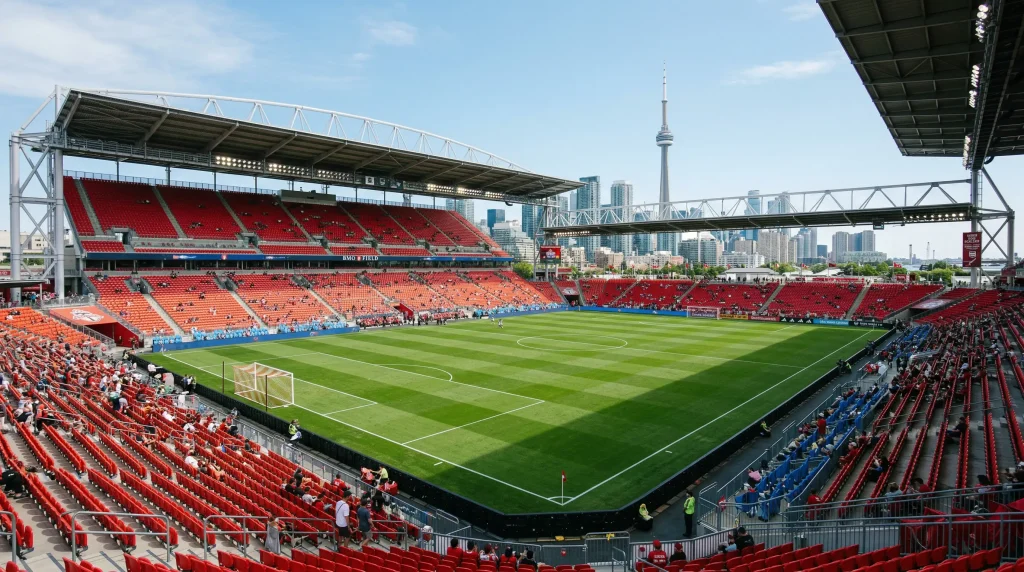
Table of Contents
Canada’s World Cup starts here — BMO Field, Liberty Village, June 12. When the referee blows the whistle for Canada versus Bosnia and Herzegovina, 30,000 supporters will release decades of anticipation into the Toronto sky. I’ve attended matches at this stadium since its 2007 opening, watching it transform from a modest soccer-specific venue into the cathedral of Canadian football it has become.
BMO Field holds particular significance for Canadian soccer history. Toronto FC’s MLS Cup victories in 2017 and 2019, multiple Canadian Championship finals, and countless national team fixtures have established the venue as English Canada’s spiritual home of the sport. For the World Cup, FIFA has mandated temporary capacity expansion to approximately 45,000 — achieved through additional seating in the south end and reconfigured premium areas.
The stadium sits within Exhibition Place, a sprawling complex that includes the Enercare Centre, Better Living Centre, and grounds that host the Canadian National Exhibition each summer. For World Cup visitors, this location provides metro accessibility (Exhibition station on Line 5 Eglinton, plus streetcar routes), proximity to downtown hotels (a 15-minute walk to King Street), and the waterfront views that make Toronto’s lakeshore so appealing.
BMO Field — Toronto’s Home of Soccer
When I first walked into BMO Field in April 2007 for Toronto FC’s inaugural match, the stadium felt ambitious for a city that barely acknowledged soccer existed. That 3-1 loss to Chivas USA drew 20,000 supporters who didn’t quite know what they were starting. Eighteen years later, the venue has hosted Major League Soccer finals, international friendlies featuring Brazil and Argentina, and the 2010 MLS All-Star Game that confirmed Toronto as a legitimate North American football market.
The stadium’s design prioritises sightlines over spectacle. Unlike newer NFL venues with massive video boards and corporate luxury dominating the experience, BMO Field keeps supporters close to the pitch. The south end’s supporters’ section — home to the Inebriatti, Red Patch Boys, and U-Sector groups — generates noise disproportionate to its capacity. During TFC’s 2017 championship run, the atmosphere rivalled European stadiums with far longer footballing traditions.
For World Cup configuration, FIFA has required several modifications. The natural grass surface — installed in 2016 after years of artificial turf — will be enhanced to meet FIFA’s playing requirements. The pitch dimensions already comply with international standards (105m x 68m), though the touchlines sit closer to the stands than regulations strictly prefer. Media facilities have been expanded, and broadcast positions now occupy portions of the upper deck that previously held regular seating.
Accessibility improvements have accompanied the World Cup preparations. Additional wheelchair positions, enhanced audio description services for visually impaired supporters, and improved wayfinding signage reflect FIFA’s inclusivity requirements. The venue has always offered reasonable accessibility by Canadian standards, but the World Cup has accelerated upgrades that might otherwise have waited years.
The roof structure covers the main stand (west side) and provides partial coverage for premium seating on the east. For June matches, Toronto’s weather should cooperate — average temperatures around 22°C with afternoon sunshine likely for the 3:00 PM kickoffs. Rain remains possible, and the open ends mean supporters in those sections should prepare for exposure.
World Cup 2026 Matches at BMO Field
BMO Field hosts six World Cup fixtures: three group stage matches plus three knockout round games. The scheduling hands Toronto Canada’s opening match, Germany versus Ivory Coast, and several high-profile Round of 32 encounters.
June 12: Canada versus Bosnia and Herzegovina, 3:00 PM ET. The tournament’s Canadian debut. Ticket demand for this fixture has exceeded any previous sporting event in Toronto’s history, with the initial allocation selling out within minutes. Secondary market prices have stabilised around C$800-1,200 for standard seating, with premium positions commanding significantly more.
June 17: Ghana versus Panama, 6:00 PM ET. This Group L fixture offers more accessible entry to World Cup football. Both nations have passionate diaspora communities in Toronto — Ghana’s concentrated in the Jane-Finch corridor and Brampton, Panama’s smaller but equally enthusiastic. Ticket prices on secondary markets sit around C$300-500, making this the most affordable group stage option at BMO Field.
June 20: Germany versus Ivory Coast, 3:00 PM ET. The marquee non-Canadian fixture. Germany’s global fanbase ensures strong demand, though the international travel required has kept prices below the Canada opener. Secondary market prices range from C$500-800. For Canadian fans wanting to experience World Cup football without the Canada match pressure, this fixture offers an ideal opportunity.
The Round of 32 matches at BMO Field (dates to be confirmed post-group stage) will feature teams from Groups A, B, C, and D. If Canada tops Group B, they won’t play their Round of 32 match in Toronto — that fixture is assigned to Vancouver. However, other Canadian venues could still host compelling knockout matchups depending on group stage results.
Canada vs Bosnia — The Opening Day in Toronto
June 12, 2026. 3:00 PM. The moment Canadian soccer has awaited since the national team’s formation in 1924. Actually, let me be more precise: the moment Canadian soccer has awaited since missing the 1986 World Cup hosted partly in Mexico, where proximity seemed to promise eventual home participation that took four decades to materialise.
Bosnia and Herzegovina arrive as giant-killers, having eliminated Italy in the UEFA playoffs through a penalty shootout victory at the Stadio Olimpico. Their supporters — drawn from Hamilton’s Bosnian community (perhaps 15,000 residents) and Kitchener-Waterloo’s substantial population — will provide vocal away backing. Expect 3,000-4,000 Bosnian fans creating their own atmosphere in the northeast corner of the stadium.
For Canada, the squad walks out knowing their nation’s football expectations have never been higher. Alphonso Davies leads from the left flank, his Bayern Munich pedigree lending international credibility. Jonathan David provides the finishing that could define Canada’s tournament. Cyle Larin, Stephen Eustáquio, and Tajon Buchanan complete a core that represents the deepest talent pool in Canadian soccer history.
The betting markets have Canada as narrow favourites — approximately 1.80 for a Canadian win, 3.50 for the draw, 4.50 for Bosnia. Given the home advantage and Bosnia’s tournament inexperience (their first World Cup since 2014), I’d expect Canada to control possession without dominating the scoreline. My prediction: Canada 2-1, with both goals coming after the hour mark as Bosnian legs tire from early pressing.
For match-day logistics, arrive early. The Exhibition Place grounds will be transformed into a fan festival zone with big screens, food vendors, and entertainment beginning at 11:00 AM. GO Transit has promised enhanced service, and the Gardiner Expressway — Toronto’s main east-west artery — should be avoided entirely. Walking from Union Station takes approximately 35 minutes and offers waterfront views along Queens Quay.
Germany vs Ivory Coast and More — Non-Canadian Matches in Toronto
Germany’s presence at BMO Field on June 20 brings a football culture that Toronto hasn’t experienced since the 2006 World Cup (when German fans flooded into bars across the city for matches played in their home country). Die Mannschaft’s travelling support typically numbers in the thousands for major tournament matches, and the North American diaspora will add to those figures.
Ivory Coast brings African football’s vibrant supporter culture to Canadian shores. Their AFCON 2024 triumph on home soil — defeating Nigeria in the final after an improbable run from near-elimination — demonstrated that Ivorian football has rediscovered its winning identity. Sébastien Haller leads the attack having overcome testicular cancer to return to elite level, a story that transcends football.
The match itself should produce goals. Germany’s high-pressing system under Julian Nagelsmann creates chances in bunches, while Ivory Coast’s counter-attacking pace through Wilfried Zaha (still effective at 33) and Simon Adingra can punish defensive mistakes. My expectation: Germany 3-1, but with Ivory Coast making the scoreline nervy until late.
Ghana versus Panama on June 17 offers Toronto’s most accessible World Cup ticket. Neither nation commands the international attention that drives prices skyward, and both diaspora communities remain smaller than Toronto’s dominant immigrant groups. This creates opportunity: genuine World Cup football at prices comparable to major league regular season events.
The Ghanaian community concentrated in Brampton and North York will treat this match as a national celebration. Panama’s supporters — perhaps 5,000 strong across the GTA — will counter with enthusiasm that belies their numbers. Expect carnival atmospheres in the surrounding streets, with food vendors offering jollof rice and sancocho within steps of each other.
Around the Stadium — Where to Watch, Eat, and Celebrate
Liberty Village has transformed from industrial wasteland to Toronto’s startup hub over the past two decades, and the neighbourhood surrounding BMO Field now offers dining and drinking options that didn’t exist when the stadium opened. For pre-match meals, King Street West between Bathurst and Dufferin provides the widest selection — Ethiopian restaurants, Korean barbecue, Italian trattorias, and Canadian pub fare all sit within walking distance.
The immediate vicinity of Exhibition Place is less developed. The grounds themselves will host FIFA’s official fan zones, with food vendors selected months in advance through FIFA’s commercial partnerships. Expect premium pricing: C$15-20 for burgers, C$10-12 for beers. Those willing to walk ten minutes north to King Street will find better value.
Post-match celebrations depend on results. If Canada wins their opener, expect King Street West to become impassable between 5:00 PM and midnight. The neighbourhood’s bars — Brazen Head, Local, Wheat Sheaf — will overflow, with crowds spilling onto patios and sidewalks. Ossington Avenue, slightly further north, offers alternatives that might be less chaotic.
For supporters seeking authentic football atmosphere, Queen Street West’s English-style pubs (the Duke of York, the Fox and Fiddle) will broadcast every match of the tournament. These establishments have been gathering points for Toronto FC supporters since the club’s inception; they understand football culture in ways that generic sports bars don’t.
Accommodation near the stadium has become challenging. The Gladstone Hotel, Drake Hotel, and Hotel Ocho — all within walking distance — sold out their World Cup blocks months ago. The downtown core (King Street, Financial District) offers more availability but requires transit or taxi travel to the stadium. Airbnb options in Parkdale and Liberty Village itself remain, though prices have tripled from typical summer rates.
Transportation deserves serious consideration. The TTC’s Line 5 Eglinton runs to Exhibition station, but service capacity during 45,000-person events will be strained. The 504 King streetcar provides an alternative but moves slowly during peak times. Walking from Union Station along the waterfront — approximately 35-40 minutes — offers the most reliable timing and pleasant scenery. For those driving, parking within Exhibition Place costs C$40-50 and fills quickly; satellite lots along Lake Shore Boulevard require shuttle transport.
The waterfront trail connecting downtown to BMO Field has been enhanced for World Cup visitors. New signage, additional lighting, and pop-up activation zones will transform the walk into a pre-match experience rather than mere transportation. Start from Harbourfront Centre (Union Station) and walk west along Queens Quay for the full effect.
