
Netherlands at the 2026 World Cup — Odds, Squad, and Group F with Japan
 Available in US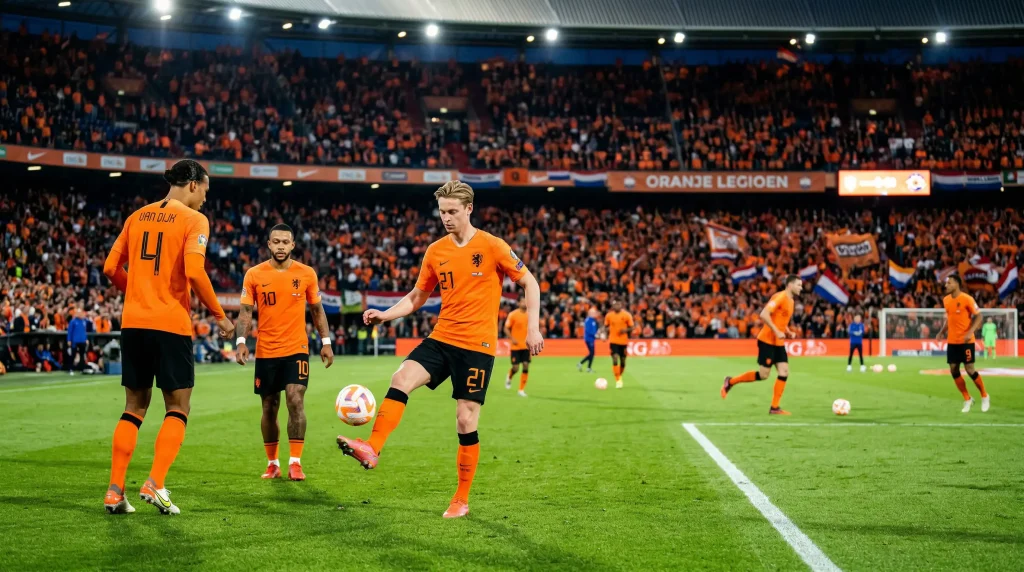
Table of Contents
The Oranje have always occupied a peculiar position in World Cup history — three finals, zero victories, producing some of football’s most celebrated players and tactics while never quite capturing the ultimate prize. The Netherlands enters the 2026 World Cup continuing this tradition of quality without championship validation, their squad featuring genuine talent that betting markets price between 18.00 and 25.00 for tournament victory. For Canadian observers, Dutch football carries particular historical resonance: the liberation of the Netherlands remains a defining moment of Canadian military history, creating bonds between nations that football competition both symbolizes and reinforces.
The 2026 Dutch squad represents transitional generation positioned between the Robben-van Persie-Sneijder era that reached the 2010 and 2014 World Cup knockout stages and whatever comes next. Virgil van Dijk anchors defense with Liverpool excellence that has defined elite centre-back play for half a decade. Cody Gakpo provides attacking threat through pace and movement that suits international football’s spaces. The supporting cast features players from Europe’s top leagues whose collective quality exceeds individual star power. Whether this configuration can challenge for championship represents the defining question for Dutch 2026 prospects.
The Oranje Squad — Key Players for 2026
Virgil van Dijk’s influence on Dutch football extends beyond his individual defensive excellence. His leadership presence organizes teammates, his passing initiates attacks from deep positions, and his aerial dominance at both ends provides set-piece threat that tournament football regularly rewards. At 34 during the 2026 World Cup, van Dijk’s physical prime may have passed, but positional intelligence and reading of play compensate for whatever pace has diminished. Liverpool’s continued reliance on his presence demonstrates his sustained elite-level quality.
Cody Gakpo established himself as genuine attacking threat through Liverpool performances that have produced goals and assists regardless of positional deployment. His versatility — capable across the front line from left wing through centre-forward — provides tactical flexibility that allows Dutch managers to adjust based on opponent analysis. Gakpo’s international tournament record includes encouraging 2022 World Cup performances that suggested his quality transfers from club to country without the translation loss some players experience.
Frenkie de Jong’s midfield ability represents both Dutch strength and vulnerability. When fit and in form, his ball-carrying and passing suit Dutch possession identity perfectly. His ability to receive under pressure and progress through midfield creates attacking opportunities that more limited midfielders cannot manufacture. However, injury concerns have plagued de Jong’s recent career, creating uncertainty about his availability and match fitness that betting markets must incorporate. A fully fit de Jong transforms Dutch midfield quality; his absence or reduced effectiveness exposes limitations that alternatives cannot fully address.
The goalkeeping situation has settled around younger options who have displaced previous generations. The emergence of reliable options provides defensive foundation that supports Dutch attacking ambitions without the occasional errors that some predecessors produced. This stability allows the defensive partnerships in front of the goalkeeper to develop consistent communication and understanding.
The attacking positions beyond Gakpo feature Memphis Depay’s experience and Xavi Simons’ emergence as competing profiles that tactical situations might favor. Depay’s career has featured brilliant moments alongside frustrating inconsistency — his 2026 World Cup role depends on form and fitness that remain unpredictable. Simons’ development at RB Leipzig and PSG has produced technical excellence and attacking involvement that suggests increasing international responsibility as he matures.
The defensive depth beyond van Dijk includes options whose club careers have produced professional reliability without matching their captain’s elite excellence. Matthijs de Ligt’s Juventus and Bayern Munich experience established him as quality centre-back partner, though questions about his concentration at crucial moments persist. Nathan Aké’s Manchester City role demonstrates Pep Guardiola’s trust in his ball-playing ability alongside defensive solidity. This variety allows Dutch managers to construct defensive partnerships suited to specific opponent characteristics.
The fullback positions offer Denzel Dumfries’ attacking energy from right-back and various left-sided options whose profiles differ based on tactical requirements. Dumfries’ Inter Milan performances have produced goals and assists that modern fullback roles demand, though his defensive positioning occasionally creates vulnerabilities that opponents exploit. Finding appropriate balance between attacking contribution and defensive responsibility at both fullback positions affects Dutch ability to compete against elite opposition whose wide play creates overloads.
Group F — Japan, Sweden, Tunisia
The Netherlands drew Group F alongside Japan, Sweden, and Tunisia — a group that presents genuine competitive challenges without featuring traditional powers. Each opponent brings characteristics that test different aspects of Dutch capability, and the Japan fixture particularly demands attention given their recent World Cup performances against European opposition.
Japan arrives as the group’s primary threat to Dutch advancement, their 2022 World Cup performances — including victories over Germany and Spain — demonstrating capability that FIFA rankings sometimes understate. Japanese pressing intensity and technical ability create problems for possession-oriented opponents who expect comfortable ball retention. The Netherlands must approach this fixture with respect that their overall tournament seeding might not suggest is necessary. Japan represents legitimate challenge whose outcome affects group positioning and subsequent bracket path.
Sweden brings familiar European competition that Dutch players understand from various competitive encounters. Swedish physical commitment and set-piece threat can trouble any opponent, though their technical limitations against superior ball-playing sides create opportunities Dutch possession should exploit. The Sweden fixture likely requires Dutch patience rather than immediate dominance — Swedish defensive organization makes early goals unlikely, and the match may require sustained pressure before chances emerge.
Tunisia provides African football’s combination of technical ability and physical commitment that European sides sometimes underestimate. Their 2022 World Cup group-stage performances, while not producing advancement, demonstrated competitive quality that their FIFA ranking understated. For betting purposes, this match creates margin markets where Netherlands should win comfortably — the question becomes degree of dominance rather than result outcome.
Netherlands Betting Odds and Value
Dutch tournament winner odds between 18.00 and 25.00 position them as dark horse rather than genuine favorite. This pricing reflects quality without championship pedigree in recent tournaments — the Netherlands has not reached a World Cup semi-final since 2014, and their Euro performances since then have ranged from disappointing to respectable without reaching decisive stages.
The case for Netherlands at these odds emphasizes squad quality that matches teams priced shorter. Van Dijk, Gakpo, de Jong (if fit), and supporting cast could compete with most tournament opponents. Dutch tactical heritage — decades of producing innovative football that shapes global approaches — creates foundation for tournament success that other nations must develop from scratch. The 2026 World Cup’s North American hosting provides neutral venues that eliminate home-continent advantages for European and South American favorites.
The case against Netherlands at these odds notes the absence of world-class striker that tournament football typically rewards. Dutch attacking variety provides options without the consistent elite goalscorer that simplifies betting predictions. The defensive reliance on van Dijk creates vulnerability if injury or form affects his performance. The midfield uncertainty around de Jong’s fitness introduces variance that pure squad assessment cannot fully incorporate.
My assessment positions Dutch probability slightly below their market-implied odds, making them modest avoid rather than clear value. The prices around 18.00 to 25.00 may overstate Dutch realistic chances given squad limitations at certain positions. For tournament betting, Netherlands represents high-variance position: if everything aligns — de Jong fit, van Dijk dominant, Gakpo scoring — their odds provide decent return, but structural limitations may produce earlier exit than overall quality suggests.
Group F winner odds around 1.75 capture expected Dutch group dominance while acknowledging Japanese competitive threat. Netherlands should qualify from this group, likely finishing first, and this market provides cleaner exposure than tournament outrights requiring five additional victories.
Dutch Roots in Canada — A World Cup Reunion
The historical bond between Netherlands and Canada creates unique World Cup viewing dynamics that purely analytical assessment might overlook. Canadian forces liberated the Netherlands in 1945, a sacrifice that Dutch communities have commemorated for eight decades. This liberation produced lasting connections: Princess Margriet was born in Ottawa during the Dutch royal family’s wartime exile, Dutch immigrants settled across Canada in significant numbers during the postwar period, and annual tulip festivals in Ottawa symbolize Dutch gratitude that subsequent generations maintain.
The Dutch-Canadian communities concentrated in Ontario — particularly the Holland Marsh agricultural region and various urban centers — maintain cultural connections that World Cup football activates. During Netherlands matches, these communities gather in ways that recreate Dutch viewing traditions on Canadian soil. For bettors seeking qualitative insight beyond statistics, these gatherings provide perspective on Dutch team morale, form assessment, and realistic expectations that casual observers cannot access.
The 2026 World Cup’s North American hosting brings Netherlands closer to these diaspora communities than previous tournaments allowed. American venues within driving distance of Canadian population centers create attendance possibilities that European or South American World Cups could not provide. Dutch-Canadian supporters planning travel to matches represent connection between betting interest and cultural investment that affects engagement levels throughout the tournament.
Our Netherlands Picks
My analysis of Netherlands’ World Cup 2026 betting landscape identifies several positions offering value for Canadian sportsbook users:
Netherlands vs Japan under 2.5 total goals at prices around 1.85 reflects likely tactical approaches from both sides. Japanese defensive organization against European possession teams typically produces low-scoring affairs, while Dutch pragmatism in competitive group fixtures limits attacking adventure. A 1-0 or 1-1 result represents the most probable outcome template.
Gakpo to score 2+ tournament goals at prices around 2.50 offers value based on his expected involvement across Dutch matches. As primary attacking threat, Gakpo receives the chances that Dutch buildup creates, and his finishing ability at Liverpool demonstrates conversion rates that justify this threshold. The group-stage fixtures against Tunisia and Sweden particularly suit his skill set.
Netherlands to win Group F at approximately 1.75 provides group-level exposure that captures expected dominance without knockout-round uncertainty. The Japan fixture represents primary obstacle, but Dutch quality and experience should handle Japanese challenge without major concern.
Van Dijk to score during tournament at prices around 3.50 offers value based on his aerial presence at set pieces. Dutch set-piece delivery quality combined with van Dijk’s timing and physical presence creates goal probability across four-to-six potential matches. His late runs into the box during attacking corners add scoring opportunities that pure defensive assessment might undervalue.
For longer-term positions, Netherlands to reach quarter-finals at prices around 2.25 provides progression exposure that captures expected advancement without requiring semi-final achievement. Their bracket path from Group F likely produces manageable Round of 32 opponent, and Dutch quality should handle that fixture regardless of group-stage performance level.
Netherlands total tournament goals over 6.5 at prices around 1.90 offers team-level exposure across expected four-to-five matches. With Gakpo leading attacks and multiple supporting scorers available, Dutch collective goalscoring should clear this threshold given favorable group-stage matchups against Sweden and Tunisia. The variety of attacking options means goals should come from multiple sources rather than concentrating in one player’s account.
De Jong to provide assist during group stage at prices around 2.75 captures his creative role when healthy. His passing range and ability to find space between opposition lines creates final-ball opportunities that pure goalscoring markets do not capture. This prop market provides exposure to de Jong’s influence without requiring him to score directly — his contribution manifests through chance creation rather than finishing.
