
Portugal at the 2026 World Cup — Ronaldo’s Last Dance and Group K Odds
 Available in US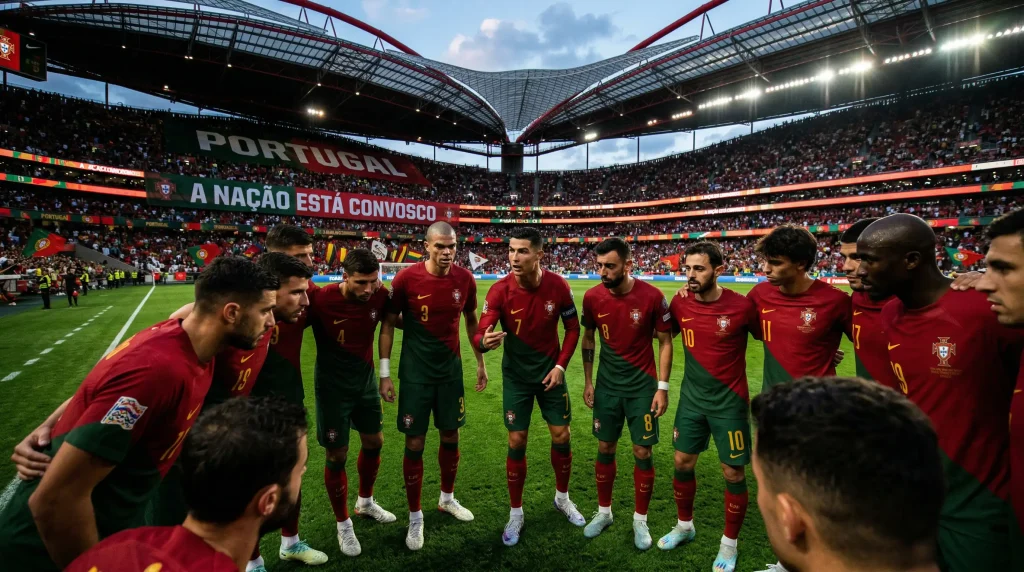
Table of Contents
Will he play? That question has dominated Portuguese football discourse since the 2022 World Cup ended, and it will define the narrative surrounding Portugal’s 2026 campaign regardless of how it is eventually answered. Cristiano Ronaldo will be 41 years old when the tournament begins. He has scored over 900 career goals. He has won everything club football offers and led Portugal to their only major international trophy at Euro 2016. The 2026 World Cup represents almost certainly his final opportunity to win the one prize that has eluded him: a World Cup winner’s medal.
Beyond the Ronaldo question lies a Portuguese squad that has developed genuine depth and quality independent of their legendary captain. The generation featuring Bruno Fernandes, Rafael Leão, and Vitinha possesses technical excellence that matches any European rival. Whether they can express that excellence while managing the expectations, pressure, and media attention that Ronaldo’s presence generates remains the uncertainty that betting markets must incorporate. Portuguese tournament winner odds between 15.00 and 20.00 reflect a squad capable of deep progression complicated by dynamics that pure talent assessment cannot capture.
Cristiano Ronaldo — The Final Chapter?
The debate over whether Cristiano Ronaldo should start for Portugal has evolved from blasphemy to legitimate tactical question over the past several years. His goalscoring continues at Al-Nassr in Saudi Arabia, where the competitive level differs dramatically from European elite football. His movement has slowed. His pressing contribution has diminished to near-zero. His presence demands tactical accommodation that shapes how Portugal must construct their approach. And yet — he remains Cristiano Ronaldo, a player whose career suggests he should never be underestimated regardless of age or circumstance.
The case for Ronaldo’s selection emphasizes what metrics cannot capture. His leadership presence, his big-match experience, and his ability to produce decisive moments through sheer force of will have characterized his entire career. The 2026 World Cup, almost certainly his final tournament, could provide the narrative conclusion that his career deserves. Portuguese football culture — and Portuguese supporters worldwide — would struggle to accept a World Cup campaign that excluded their greatest-ever player while he remained willing and available to compete.
The case against Ronaldo’s selection emphasizes tactical flexibility that his presence restricts. Portugal with Ronaldo must construct attacks through his position, limiting options for more mobile alternatives. His defensive non-contribution creates asymmetry that opponents can exploit. The younger Portuguese attackers — Leão, Diogo Jota, João Félix — offer different profiles that collective football might utilize more effectively than the individual-focused approach Ronaldo requires. A Portugal built around modern pressing principles and positional interchange might perform better than one constructed to accommodate a 41-year-old who cannot fulfill the physical demands those systems require.
My assessment suggests Ronaldo will be selected for the 2026 World Cup squad — the cultural and commercial factors make exclusion nearly impossible — but his starting role remains uncertain. A scenario where Ronaldo begins matches before substitution, or serves as impact substitute himself, offers compromise between respecting his legacy and optimizing Portuguese tactical approach. Betting markets that price Portuguese performance should incorporate this uncertainty: a full Ronaldo-centric approach differs meaningfully from a rotation or substitute role.
Beyond CR7 — Portugal’s Talent Pool
The Portuguese squad depth that has developed over the past decade means that life after Ronaldo — or alongside reduced-role Ronaldo — need not represent decline. The current generation features players at elite European clubs whose quality matches any national team in the tournament.
Bruno Fernandes provides attacking midfield excellence through Manchester United performances that have often exceeded his club’s collective results. His creativity, set-piece delivery, and goalscoring from midfield positions create attacking threat that does not depend on Ronaldo’s presence. Bruno’s leadership qualities have developed as he has matured, positioning him as natural captain candidate when Ronaldo eventually departs. At the 2026 World Cup, Bruno will be 31 — prime age for players whose game relies on intelligence and technique rather than pace and athleticism.
Rafael Leão represents the future of Portuguese attacking football, his AC Milan performances establishing him among Europe’s elite wingers. His combination of pace, dribbling ability, and goalscoring threat creates one-on-one situations that defenders cannot solve through conventional approaches. Leão’s inconsistency — he occasionally disappears from matches — has frustrated those who recognize his ceiling, but tournament football’s knockout format could suit his ability to produce decisive individual moments regardless of overall match contribution.
Vitinha’s midfield development at Paris Saint-Germain produced the technical excellence that Portuguese football traditionally values. His passing range and positional intelligence suit possession-oriented systems that maximize Portuguese attacking talent. The defensive midfield responsibilities that tournament football sometimes demands stretch his profile, but partnered with appropriate defensive cover, Vitinha enables Portuguese buildup that can compete with any opponent’s pressure schemes.
The defensive positions feature quality that previous Portuguese generations sometimes lacked. Rúben Dias has established himself among the world’s elite centre-backs through Manchester City performances that demonstrate both physical dominance and distribution ability. António Silva’s emergence at Benfica suggested another generational talent at central defence. The fullback positions offer various profiles — defensive solidity or attacking contribution depending on tactical requirements — that allows formation flexibility across different opponent matchups.
Diogo Costa’s goalkeeping development positions him as long-term Portuguese number one, his distribution ability complementing shot-stopping reliability that tournament football demands. The transition from Rui Patrício represents upgrade rather than decline, creating defensive foundation that supports Portuguese attacking ambitions.
The attacking depth beyond the primary options includes João Félix, whose career trajectory has featured more moves than sustained excellence at any single destination. His technical ability remains evident when confidence aligns with form, but predicting when that alignment occurs has frustrated managers and supporters alike. Diogo Jota’s Liverpool career established him as elite-level finisher whose movement creates goal opportunities regardless of system. Gonçalo Ramos emerged at Benfica with performances suggesting he could eventually inherit the centre-forward role that Ronaldo has occupied for two decades. This variety provides tactical flexibility that allows Portuguese managers to adjust based on opponent analysis and match situations.
The midfield options beyond Vitinha include João Palhinha’s defensive presence and Rúben Neves’ distribution ability from deeper positions. These alternatives allow formation adjustments that either prioritize defensive security or attacking contribution depending on match context. Portuguese midfield depth matches any tournament competitor, creating rotation possibilities without significant quality dropoff across group-stage and knockout-round demands.
Group K — DR Congo, Uzbekistan, Colombia
Portugal’s Group K draw combines African emergence, Central Asian debut, and South American quality in a group that should not threaten Portuguese advancement but presents genuine competitive fixtures. DR Congo, Uzbekistan, and Colombia each bring characteristics that test different aspects of Portuguese capability.
DR Congo arrives at the 2026 World Cup with a squad featuring European-based talent whose individual quality sometimes exceeds their collective results. Congolese football’s potential has long promised more than it has delivered at World Cup level, but this generation includes players from top European leagues whose experience prepares them for tournament intensity. For Portugal, this match creates opportunity for comfortable victory while demanding professional attention — Congolese athleticism and individual skill can punish complacency.
Uzbekistan’s World Cup debut represents Central Asian football’s continued development, their qualification demonstrating competitive improvement in a region traditionally dominated by other Asian powers. Their squad lacks the individual quality to threaten Portuguese advancement, but their defensive organization and collective effort could produce lower-scoring affair than casual observers expect. Portugal must demonstrate patience against opponents who prioritize defensive structure over attacking ambition.
Colombia brings South American quality and tournament experience that the group’s other opponents lack. Their squad features players from top European leagues alongside domestic standouts whose technical ability matches Portuguese counterparts. The Colombia fixture likely determines group positioning, with both nations favored over DR Congo and Uzbekistan. Colombian flair and individual creativity could produce entertaining match whose outcome remains uncertain longer than Portuguese supporters would prefer.
Portugal’s Odds — Where the Value Sits
Portuguese tournament winner odds between 15.00 and 20.00 position them as dark horse rather than genuine favourite. This pricing incorporates both their talented squad and the uncertainties — Ronaldo’s role, tactical cohesion, knockout-round mentality — that complicate straightforward assessment.
The case for Portugal at these odds emphasizes squad quality that matches teams priced shorter. Bruno Fernandes, Leão, Dias, and supporting cast could compete with any opponent in the tournament. Portuguese Euro 2016 victory demonstrated their ability to win knockout matches through resilience rather than dominance — a capability that serves tournament football regardless of aesthetic preferences. If Ronaldo’s situation resolves productively, Portuguese ceiling matches any team outside the clear favourites.
The case against Portugal at these odds notes the psychological and tactical complications that Ronaldo’s presence creates. The distraction, the media attention, the tactical accommodation — these factors consume energy that Portuguese players could otherwise direct toward competition. Previous tournaments with Ronaldo approaching reduced effectiveness have produced disappointing results despite squad quality that suggested deeper progression. The pattern may repeat in 2026 unless management navigates Ronaldo dynamics more skillfully than predecessors achieved.
My assessment positions Portuguese probability near their market-implied odds, making them neither clear value nor obvious avoid. The prices around 15.00 to 20.00 reflect appropriate balance between quality and complication. For tournament betting, Portugal represents moderate-variance position: resolution of Ronaldo dynamics determines whether their odds provide value or overstate their realistic chances.
Group K winner odds around 1.50 provide cleaner exposure that avoids knockout-round uncertainty. Portugal should navigate this group successfully, likely finishing first ahead of Colombia, and this market captures expected group performance without requiring deep tournament progression.
Progression markets offer tiered exposure based on bracket advancement expectations. Portugal to reach Round of 16 at prices around 1.20 requires merely group qualification — achievable given their Group K draw. Portugal to reach quarter-finals around 2.00 adds the Round of 32 hurdle that Portuguese quality should handle. These markets allow calibrated exposure based on confidence level in Portuguese ability to translate group-stage form into knockout-round results.
Canada’s Portuguese Community and World Cup Fever
The 2026 World Cup brings particular significance for Portuguese-Canadian communities who represent one of Canada’s largest European diaspora populations. Toronto’s Little Portugal neighbourhood, the Portuguese concentrations in Montreal and Vancouver, and the scattered communities across Canadian cities will transform into extensions of Lisbon during Portugal’s World Cup matches. For Canadian bettors connected to these communities, understanding Portuguese sentiment provides information advantages that pure analytical assessment lacks.
Little Portugal in Toronto — centred on Dundas West and College Street — features cafes, restaurants, and social clubs where Portuguese football dominates conversation. During major tournaments, these establishments fill hours before kickoff, creating atmosphere that rivals anything in Portugal itself. The emotional investment produces public sentiment that bettors can observe directly: how do those closest to Portuguese football culture perceive team form, Ronaldo’s fitness, tactical direction, and realistic expectations?
The viewing culture extends beyond Portuguese-born residents to second and third-generation Portuguese-Canadians who maintain cultural connections through football support. This broader community engagement means Portuguese matches attract diverse crowds whose shared investment creates information-rich environments. For bettors seeking qualitative insight beyond statistics, these viewing parties provide valuable perspective that sports media coverage alone cannot replicate.
The cross-border dimension becomes relevant for Portuguese-Canadians planning match attendance. American venues within driving distance of Toronto — potentially New Jersey, Boston, or Philadelphia for knockout rounds — could host Portuguese matches that attract substantial diaspora crowds. The proximity creates travel possibilities that European supporters cannot easily replicate, producing stadium atmospheres where Portuguese supporters approach numerical parity with other nations’ fans despite playing away from Europe.
For betting purposes, the Portuguese-Canadian community provides sentiment gauge that affects Ontario sportsbook pricing. Portuguese public money influences lines in ways that analytical bettors can potentially exploit when emotional investment diverges from probability assessment. Understanding when community optimism reflects genuine insight versus hopeful thinking creates edges that those outside these communities cannot easily replicate.
Portugal Value Bets and Market Analysis
My analysis of Portugal’s World Cup 2026 betting landscape identifies several positions offering value for Canadian sportsbook users:
Bruno Fernandes to score 2+ tournament goals at prices around 2.75 captures his expected involvement across Portugal’s probable deep bracket run. His penalty-taking responsibilities, set-piece involvement, and attacking positioning create goal probability that exceeds what this price implies. Across four-to-six matches, Bruno’s goal accumulation should clear this threshold regardless of Ronaldo’s role.
Portugal vs Colombia under 2.5 total goals at approximately 1.90 reflects likely tactical approaches from both sides. Colombian defensive organization against European possession teams typically produces low-scoring affairs, while Portuguese pragmatism in competitive matches limits attacking adventure. A 1-0 or 2-0 Portuguese victory represents the most probable outcome template.
Leão to score during group stage at prices around 2.25 offers value based on his attacking role against inferior group opponents. DR Congo and Uzbekistan present matchups where Leão’s pace and dribbling should create goal opportunities. The market may undervalue his involvement if pricing assumes Ronaldo absorbs primary scoring responsibility.
Portugal to reach quarter-finals at prices around 2.00 provides progression exposure that captures expected knockout advancement without requiring semi-final achievement. Their bracket path from Group K likely produces manageable Round of 32 opponent, and Portuguese quality should handle that fixture regardless of Ronaldo dynamics. This market avoids the complications that deeper progression encounters against elite opposition.
For longer-term positions, Portugal to reach semi-finals at prices around 4.00 offers value if you believe Ronaldo dynamics resolve productively. The squad quality genuinely supports this level of advancement, and the price reflects skepticism that may prove excessive if Portuguese management navigates their challenges effectively.
Ronaldo to score during tournament at prices around 1.40 provides near-certainty market exposure assuming he receives meaningful minutes. Regardless of starting role, Ronaldo’s penalty involvement and substitute appearances should produce at least one goal across four-to-six Portuguese matches. This market captures his continued goalscoring ability without requiring the volume that starter expectations might demand.
Portugal total tournament goals over 7.5 at prices around 1.85 offers team-level exposure across expected four-to-five matches. The favorable group-stage matchups against DR Congo and Uzbekistan suit high-scoring performances, while Portuguese attacking depth ensures multiple contributors regardless of Ronaldo’s involvement level. This market captures collective Portuguese excellence without relying on any single scorer’s production. The variety of attacking options means goals should come from multiple sources rather than concentrating in one player’s account.
