
Spain at the 2026 World Cup — The Youngest Contenders in Group H
 Available in US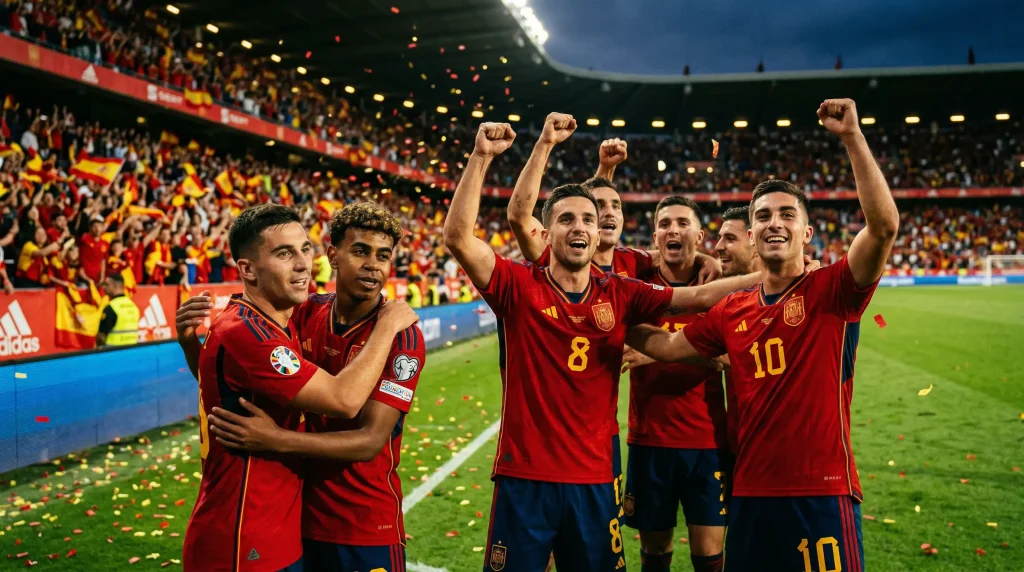
Table of Contents
The average age of Spain’s Euro 2024 starting lineup was 24 years old — the youngest of any finalist in the tournament’s history. They won anyway. That victory, achieved through football that combined traditional Spanish possession with devastating attacking transitions, announced a generational shift that positions La Roja as genuine World Cup 2026 contenders. Lamine Yamal was 16 during that European triumph. Pedri was 21. Nico Williams had just turned 22. This is not a squad approaching its window — this is a squad whose window is only beginning to open.
Spanish football spent the years following their 2010 World Cup victory searching for the next generation capable of matching that achievement. The 2014 World Cup produced group-stage embarrassment. The 2018 and 2022 tournaments ended in Round of 16 penalty defeats. Euro 2024’s trophy represented the breakthrough that suggested tiki-taka’s evolution had finally produced a squad capable of tournament success. The 2026 World Cup, arriving two years later with the same core intact and further matured, provides the opportunity to complete Spanish football’s generational restoration.
Yamal, Pedri, and Spain’s Generational Core
Lamine Yamal will be 18 years old when the 2026 World Cup begins — and already he will have won a major international trophy, established himself as a Barcelona starter, and generated transfer valuations exceeding €150 million. His emergence represents the most dramatic young talent arrival in football since Mbappé’s 2018 World Cup breakthrough. What separates Yamal from other teenage prospects is the combination of technical excellence with decision-making maturity that usually requires years of experience to develop. He does not play like a teenager. He plays like a finished product who happens to be extraordinarily young.
The right-wing position that Yamal occupies produces attacking threat that defenses cannot neutralize through standard approaches. His dribbling ability in tight spaces creates one-on-one opportunities that he converts with alarming regularity. His crossing and final-ball delivery provide service for teammates. His movement off the ball drags defenders out of position, creating space for others to exploit. At Euro 2024, opponents tried man-marking, zone defense, double-teaming — none worked consistently. By the 2026 World Cup, Yamal will have two more years of elite-level experience that should only sharpen these already exceptional capabilities.
Pedri provides the midfield foundation upon which Spanish attacking excellence operates. His Barcelona career has established him as one of football’s elite central midfielders, his positional intelligence and passing accuracy maintaining Spain’s possession identity while enabling quicker transitions than previous tiki-taka iterations. At 23 during the 2026 World Cup, Pedri enters his prime having accumulated Champions League and international tournament experience that few players his age can match. His ability to control match tempo — accelerating when opportunities arise, slowing when consolidation is required — gives Spain tactical flexibility that pure possession teams sometimes lack.
Nico Williams offers left-sided attacking threat that balances Yamal’s right-wing dominance. His Athletic Club development produced directness and pace that suits transitional football, complementing Yamal’s more technical approach with explosive athleticism. Williams’ Euro 2024 performances, including the opening goal in the final against England, demonstrated his ability to perform at maximum pressure moments. The Williams-Yamal combination creates dual-threat width that forces opponents into impossible defensive choices: concentrate on one side, and the other exploits the resulting space.
The supporting cast extends Spanish depth beyond the obvious stars. Rodri’s defensive midfield presence provides structure that allows Pedri creative freedom. Dani Olmo’s versatility offers attacking options from multiple positions. Álvaro Morata, though inconsistent across his career, provides experienced centre-forward presence that younger alternatives lack. Unai Simón’s goalkeeping has developed from promising to reliable through accumulated international experience. This depth means Spain can rotate without significant quality dropoff — crucial across a 39-day tournament.
The defensive structure features established partnerships that tournament football rewards. Aymeric Laporte’s experience, Robin Le Normand’s emergence, and Dani Carvajal’s veteran right-back excellence create defensive foundation that supports Spanish attacking ambitions. Marc Cucurella’s left-back energy provides defensive security alongside attacking contribution. These defenders understand their roles within Spanish tactical systems, creating reliability that allows attackers to commit forward without fearing defensive exposure.
The goalkeeping position has settled after years of uncertainty that plagued Spanish selection. Unai Simón’s development at Athletic Club produced shot-stopping reliability and distribution ability that suits Spanish buildup preferences. His Euro 2024 performances, including crucial saves in knockout matches, demonstrated composure under pressure that tournament football demands. The backup options provide quality depth without threatening Simón’s starting position, creating stability that allows defensive partnerships to develop consistent communication.
The depth positions reveal Spanish football’s continued talent production. Ferran Torres offers attacking versatility from multiple forward positions. Mikel Merino’s emergence added midfield options that complement rather than duplicate Pedri’s profile. Younger talents pushing for selection — including La Masia products and players from other Spanish academies — create internal competition that sharpens first-choice performers. This depth allows rotation without catastrophic quality dropoff, important across a tournament demanding seven matches for the eventual champion.
Group H — Cabo Verde, Saudi Arabia, Uruguay
Spain’s Group H draw combines tournament debutant, regional dark horse, and South American pedigree in a group that should not threaten Spanish advancement but demands professional attention. Cabo Verde, Saudi Arabia, and Uruguay each present distinct challenges that test different aspects of Spanish capability.
Cabo Verde’s World Cup debut represents one of the tournament’s most compelling underdog stories. Their qualification through African preliminary rounds demonstrated competitive improvement that smaller nations rarely achieve, but their squad lacks the individual quality to threaten Spanish advancement. For betting purposes, this match creates margin markets where Spain should win heavily — the question becomes degree of dominance rather than result. Spain -4.5 Asian handicap represents aggressive pricing that Spanish attacking variety could justify against limited defensive organization.
Saudi Arabia arrives at the 2026 World Cup with the confidence that defeating Argentina in the 2022 group stage provided. That result — one of the greatest upsets in World Cup history — demonstrated that Saudi defensive organization and collective effort can frustrate even the world’s best. However, expecting that result to repeat against Spain presents different challenges: Spanish possession control denies the ball access that Argentina’s transitional approach provided. Saudi Arabia will find fewer counter-attacking opportunities against opponents who maintain 65-70% possession as baseline expectation.
Uruguay brings South American quality and tournament experience that the group’s other opponents lack. Their squad features players from top European leagues whose individual quality matches Spanish counterparts at several positions. Uruguay’s defensive resilience — historically one of South American football’s defining characteristics — creates potential for low-scoring affair where single moments determine outcomes. The Spain vs Uruguay fixture likely determines group positioning, with both nations favored over Cabo Verde and Saudi Arabia for advancement.
The group winner receives more favorable Round of 32 placement than the second-place finisher, creating incentive for Spain to pursue maximum points rather than merely secure qualification. This competitive motivation suggests Spain deploys strong lineups throughout group stage, including against Cabo Verde where rotation might otherwise seem appropriate.
Spain’s Betting Odds — Euro 2024 Champions on the Rise
Spanish tournament winner odds between 7.00 and 10.00 position them among genuine favorites alongside France and England. This pricing reflects their Euro 2024 triumph and the youth of their core players — a combination suggesting they may have arrived at the optimal moment for World Cup challenge. Whether this pricing represents value or accurate assessment depends on how you weight various factors.
The case for Spain at these odds emphasizes their Euro 2024 performances, which combined possession excellence with attacking efficiency that previous Spanish teams lacked. They scored multiple goals in every knockout match. They defeated Germany in extra time. They handled England’s pressure in the final without appearing overwhelmed. This was not vintage tiki-taka grinding out results — this was dynamic football that created and converted chances against elite opposition. The 2026 squad should only improve as young players gain additional experience.
The case against Spain at these odds notes the difference between European and World Cup competition. South American teams present tactical challenges that European opponents rarely replicate. The physical demands of a 39-day tournament exceed Euro 2024’s 30-day format. The knockout-round pressure intensifies when matches carry World Cup stakes rather than continental championship significance. Additionally, Spain’s recent World Cup record — two consecutive Round of 16 penalty exits — suggests that European success does not automatically transfer to World Cup context.
My assessment positions Spanish probability slightly above their market-implied odds, making them modest value for tournament consideration. The squad quality genuinely matches the best in the tournament. The tactical coaching under Luis de la Fuente demonstrated adaptability that previous Spanish managers sometimes lacked. The youth of the core suggests energy and recovery advantages over older squads in late-tournament matches. These factors combine into a profile where Spanish odds represent fair pricing with slight undervaluation.
Group H winner odds around 1.30 provide low-risk Spanish exposure that captures expected group dominance. Spain should navigate this group successfully, likely finishing first, and this market avoids knockout-round variance. The Uruguay fixture creates primary uncertainty, but Spanish quality and tactical sophistication should handle Uruguayan challenge without major concern.
Progression markets offer alternative exposure based on bracket advancement expectations. Spain to reach semi-finals at prices around 2.25 requires three knockout victories after group qualification — achievable given expected favorable early-round opponents. Spain to reach final around 3.50 adds the semi-final hurdle where elite opposition concentrates. These markets capture expected deep progression while allowing for the knockout-round penalties that have haunted recent Spanish campaigns.
The head-to-head markets between Spain and other tournament favorites create speculative opportunities before bracket paths become known. Spain vs France prices, Spain vs England prices, and Spain vs Argentina prices all attract betting interest despite requiring specific bracket outcomes. The historical context these matchups carry influences pricing beyond current squad comparison — Spain’s Euro 2024 final victory over England, for instance, affects how markets price potential rematch scenarios.
Top scorer markets within Spain provide alternative exposure to their attacking quality. Yamal and Williams both carry scoring potential that could produce Golden Boot contention if Spain reaches deep tournament stages. These individual markets capture attacking involvement without requiring the team result that tournament outright positions demand. The young ages of Spain’s primary attackers suggest they may outperform historical goalscoring rates as tournament pressure becomes familiar rather than novel.
Tiki-Taka Evolved — Spain’s Tactical Identity in 2026
The tiki-taka possession football that defined Spain’s 2008-2012 golden era has evolved into something more direct and dangerous. Modern Spanish football maintains possession as foundation but adds vertical transitions that previous iterations lacked. The change reflects both generational talent differences and tactical evolution across global football — what worked in 2010 would not work in 2026 without adaptation.
Luis de la Fuente’s tactical approach emphasizes attacking speed when opportunities arise. Previous Spanish managers sometimes maintained possession for its own sake, circulating the ball without clear attacking purpose. De la Fuente’s Spain recognizes when defensive structures create exploitable space and attacks immediately rather than continuing patient buildup. This directness surprised opponents at Euro 2024, who expected the traditional Spanish approach and found themselves exposed by rapid transitions.
The wide positions drive this tactical evolution. Yamal and Williams provide pace and dribbling that previous Spanish wingers lacked. Their willingness to attempt defenders one-on-one creates attacking threat that possession circulation alone cannot produce. When these attempts succeed, Spanish attacks become dangerous immediately. When they fail, Spanish midfield structure recovers possession and restarts the sequence. This combination of individual brilliance with collective organization defines modern Spanish football’s competitive advantage.
Defensively, Spain has improved from the vulnerability that contributed to 2014’s disaster. The back line presses higher than before, trusting recovery speed and collective organization to handle balls played behind. This pressing creates midfield compactness that suffocates opponents in their own third, generating turnovers in dangerous positions that enable immediate attacking threat. The balance between pressing intensity and defensive security represents tactical sophistication that tournament football rewards.
For betting purposes, understanding Spanish tactical identity shapes match-level predictions. Against defensive opponents like Cabo Verde, Spain will dominate possession but may need patience to create clear chances. Against competitive opponents like Uruguay, the tactical battle produces more variance — Spanish possession may not translate into chances if opponents defend with discipline and organization. Recognizing which matchups favor Spanish approach and which present difficulties informs both match-winner and total-goals betting.
The set-piece dimension adds attacking route that previous Spanish teams underutilized. Modern Spanish football recognizes that tournament matches often produce few open-play chances against organized defenses, making set-piece conversion crucial. The height in Spanish back line — Laporte, Le Normand, and others — provides aerial threat from corners and free kicks that supplements their open-play excellence. This dual threat complicates opponent defensive planning: sit deep to prevent open-play chances, and expose yourself to set-piece danger.
The psychological dimension of Spanish tactical identity has shifted alongside technical evolution. Previous Spanish teams sometimes appeared hesitant to abandon possession even when attacking opportunities presented themselves. Modern Spanish players, particularly Yamal and Williams, possess the confidence to attempt ambitious individual actions that risk losing the ball. This willingness to accept possession loss in exchange for attacking threat represents cultural shift that makes Spanish football more dangerous and less predictable than historical iterations.
Spain Value Bets and Player Props
My analysis of Spain’s World Cup 2026 betting landscape identifies several positions offering value for Canadian sportsbook users:
Yamal to score 3+ tournament goals at prices around 3.25 captures his expected involvement across Spain’s probable deep bracket run. If Spain reaches semi-finals or beyond, Yamal playing six or seven matches creates opportunities for this threshold given his attacking role and shot volume. His penalty involvement — either taking them or winning them through dribbling — adds goal probability beyond open-play chances. The market sometimes underprices young players whose sample sizes seem insufficient, creating value for those who recognize Yamal’s exceptional quality.
Spain vs Cabo Verde over 4.5 total goals at prices around 2.00 reflects expected Spanish dominance against tournament debutants. Cabo Verde’s defensive capabilities, while improved through qualification, remain insufficient to contain Spanish attacking variety across 90 minutes. Their own attacking ambitions create additional goal probability beyond Spanish scoring alone. High-scoring Spanish victories against inferior opposition characterize their recent competitive history.
Spain vs Uruguay under 2.5 total goals at approximately 1.95 provides contrarian position on the competitive group fixture. Both teams possess defensive organization capable of limiting opposition chances, and the high stakes create incentive for cautious tactical approaches. Uruguayan defensive tradition particularly suits low-scoring affairs against possession-dominant opponents. The public money attracted by Spanish attacking star power may push overs prices lower than analytical assessment supports.
Pedri to provide most assists for Spain during group stage at prices around 4.50 offers value based on his creative role. While Yamal and Williams attract defensive attention through direct threat, Pedri operates in spaces that produce final-ball opportunities. His passing accuracy and vision create assist potential that pure goalscoring markets do not capture. This prop market provides exposure to Pedri’s influence without requiring him to score directly.
Spain to win tournament without conceding more than 4 goals at prices around 8.00 captures their defensive improvement alongside expected deep progression. Euro 2024 demonstrated that modern Spanish football can defend without sacrificing attacking quality. Across six or seven tournament matches, limiting opposition to four total goals requires consistent defensive excellence — achievable given Spanish defensive personnel and tactical organization.
For longer-term positions, Spain to reach final at prices around 3.50 captures expected bracket progression without requiring the trophy lift. Their Euro 2024 final appearance demonstrates recent ability to reach decisive matches. This market construction acknowledges Spanish quality through semi-finals while avoiding the single-match variance that finals produce.
Spain total tournament goals over 12.5 at prices around 2.10 provides team-level exposure across expected deep tournament run. With Yamal, Williams, Pedri, and multiple supporting scorers all contributing, Spanish collective goalscoring should clear this threshold across six or seven matches. The favorable group-stage matchups against Cabo Verde and Saudi Arabia particularly suit high-scoring performances that establish this position favorably before knockout-round competition reduces scoring opportunities.
Williams to score in knockout rounds at prices around 2.50 offers value based on his Euro 2024 performances in decisive matches. His final goal against England demonstrated composure at maximum pressure moments. The knockout-stage environment where individual brilliance often determines outcomes suits Williams’ direct approach better than grinding group-stage affairs where patience predominates. This prop market captures his clutch potential without requiring group-stage production that Yamal may claim.
Rodri to be named tournament’s best player at prices around 8.00 provides speculative exposure to his continued excellence. His Euro 2024 Player of the Tournament award demonstrated voter recognition of his defensive midfield contribution. If Spain wins the World Cup, Rodri’s role in enabling their attacking excellence may earn similar recognition. This market captures the possibility of Spanish tournament victory through their most experienced core player rather than their emerging stars. His Manchester City pedigree adds credibility that pure international performances alone might not establish.
Spain first goal before 20 minutes in any group match at prices around 1.75 offers value based on their pressing intensity. Modern Spanish football creates early chances through high pressing that opponents struggle to handle in match opening phases. Across three group-stage fixtures, the probability of at least one early goal exceeds what this price implies. The Cabo Verde and Saudi Arabia matchups particularly suit early aggression that produces quick leads.
