
Switzerland at the 2026 World Cup — Canada’s Toughest Group B Rival
 Available in US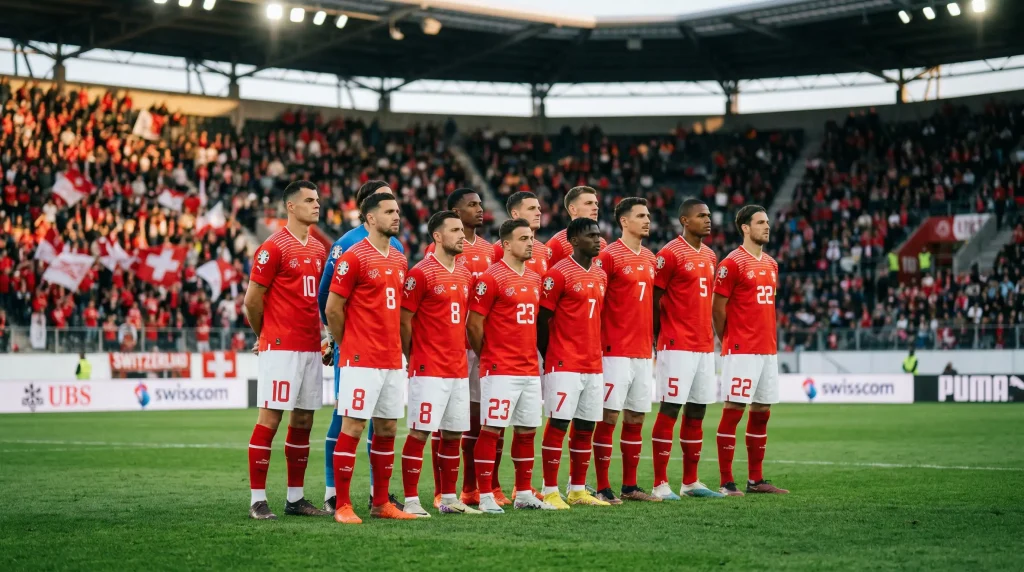
Table of Contents
June 24, 2026. BC Place, Vancouver. The final Group B matchday brings Switzerland vs Canada in a fixture that could determine which nation tops the group and secures the more favorable Round of 32 bracket path. For Canadian supporters, this match represents the tournament’s most significant group-stage challenge — the Swiss bring European pedigree, tournament experience, and the quiet efficiency that has produced consistent knockout-round qualification across recent major championships. Understanding Switzerland means understanding the obstacle that stands between CanMNT and maximum home-soil advantage.
The Swiss national team operates with a consistency that escapes attention because it lacks drama. They reach knockout rounds. They compete respectably. They exit without embarrassment but also without the deep runs that generate lasting memories. This profile — solid but not spectacular — positions them perfectly to frustrate Canadian ambitions. Switzerland’s betting odds around 60.00 to 80.00 for tournament victory reflect their ceiling limitations, but their Group B odds tell a different story: Switzerland represents the primary threat to Canadian group dominance, and the Vancouver fixture may prove the tournament’s most important 90 minutes for CanMNT supporters.
Switzerland’s Squad — The Quiet Overachievers
Swiss football development produces players whose technical excellence and tactical intelligence exceed what their league’s relative profile might suggest. The pathway from Swiss Super League through top European competitions has created a generation of players whose club careers at elite institutions prepare them for tournament intensity.
Granit Xhaka’s career trajectory from Arsenal captain to Bayer Leverkusen’s unbeaten league campaign demonstrates his continued elite-level quality. His midfield presence provides Swiss football’s foundation — defensive security, distribution ability, and leadership presence that organizes teammates. At the 2026 World Cup, Xhaka will be 33, his experience compensating for whatever physical decline age has produced. His ability to control match tempo suits Swiss tactical preferences perfectly.
Manuel Akanji’s Manchester City role establishes him among Europe’s elite centre-backs, his positional intelligence and distribution ability suiting Pep Guardiola’s demanding standards. Akanji’s partnership with various City defenders demonstrates his adaptability, a quality that international football’s fluctuating lineups rewards. His aerial presence at set pieces adds goal threat that purely defensive assessment might overlook.
The attacking positions feature Breel Embolo’s physical presence and Dan Ndoye’s emerging pace, creating variety that allows Swiss managers to adjust based on opponent analysis. Embolo’s injury history has limited his career progression, but when fit he provides target-man profile that Swiss buildup can utilize. Ndoye’s breakthrough at Bologna produced the direct attacking threat that Swiss football sometimes lacks — his ability to beat defenders one-on-one creates chances that more patient Swiss approaches cannot manufacture.
The goalkeeping situation has produced reliable options whose consistency suits tournament football’s demands. Swiss goalkeepers historically provide clean-sheet probability that defensive metrics alone might understate, their positional excellence limiting shot quality rather than relying on spectacular saves. This foundation supports the organized defensive approach that characterizes Swiss tournament performances.
The defensive depth beyond Akanji includes options whose club careers have produced professional reliability at various European levels. Ricardo Rodríguez’s left-back experience provides set-piece delivery alongside defensive solidity, though his pace limitations against quick wingers create matchup vulnerabilities. The right-back position offers various profiles depending on tactical requirements — more defensive or more attacking based on opponent analysis.
The midfield organization beyond Xhaka features players whose roles complement rather than duplicate his profile. More creative options provide attacking contribution when tactical situations demand forward thrust, while defensive alternatives offer protection when opponent quality requires conservative approach. This variety allows Swiss managers to construct midfield configurations suited to specific opponents — important flexibility across group-stage and knockout-round demands.
The depth positions reveal Swiss football’s continued player development despite their league’s limited profile. Young talents pushing for selection create internal competition that sharpens established performers, while experienced alternatives provide options when injuries or suspensions affect first-choice availability. This squad depth — often overlooked when assessing Swiss prospects — enables rotation without catastrophic quality dropoff across tournament duration.
Euro 2024 Quarter-Finalists — What That Means for Group B
Switzerland’s Euro 2024 campaign — reaching quarter-finals before penalty defeat to England — demonstrated capabilities that Group B opponents must respect. Their group-stage performances included victory over Hungary and draw against Scotland, followed by knockout-round elimination of Italy that announced Swiss arrival as genuine tournament force. This recent pedigree shapes how betting markets price Group B outcomes.
The Italy victory particularly matters for Canadian assessment. Swiss organization and defensive discipline contained one of Europe’s traditional powers, producing 2-0 victory that reflected merit rather than fortune. That performance suggests Swiss capability against technically superior opponents extends beyond merely frustrating them — Switzerland can win convincingly when tactical matchups favor their approach.
The England quarter-final, though ending in penalty defeat, demonstrated Swiss ability to compete with tournament favorites through full match duration. They reached penalties against a side that subsequently reached the final, validating their tournament credentials despite ultimate elimination. This competitive resilience characterizes Swiss football across recent tournaments — they do not collapse against superior opponents, instead requiring those opponents to earn their victories through sustained excellence.
For Canadian betting purposes, Swiss Euro 2024 performance establishes baseline expectations that pure FIFA ranking might understate. The Nati represent genuine threat whose quality has been validated at the highest recent competitive level. Dismissing Switzerland as merely European filler ignores evidence that their current generation matches their strongest historical squads.
Switzerland vs Canada — The Match That Decides Group B
The June 24 fixture at BC Place carries significance that transcends the three points available. If both nations enter the final matchday with qualification secured — the expected scenario given Bosnia and Qatar’s relative limitations — this match determines group positioning that affects subsequent bracket paths. The winner likely faces weaker Round of 32 opposition, creating cascading advantages that could extend deep into knockout rounds.
From Canadian perspective, this match presents the tournament’s first genuine test against established European quality. Bosnia and Herzegovina bring their own challenges, and Qatar provides Asian competition, but Switzerland represents the European tournament pedigree that CanMNT has rarely faced in competitive settings. How Canada handles Swiss organization, experience, and tactical discipline reveals whether home-soil advantage can compensate for competitive history gaps.
The Vancouver setting provides CanMNT with maximum home advantage — the same venue where they defeated Mexico in World Cup qualifying, the same crowd energy that has driven Canadian football’s recent rise. Swiss players will face atmosphere unlike anything their European club careers produce, with 50,000+ supporters creating wall of sound that affects concentration and communication. Whether this advantage proves decisive or whether Swiss experience neutralizes crowd influence shapes match outcome in ways tactical analysis cannot fully capture.
The tactical matchup favors careful approaches from both sides. Switzerland will respect Canadian attacking quality — Alphonso Davies’ pace, Jonathan David’s finishing — while trusting their defensive organization to limit clear chances. Canada will recognize that Swiss counter-attacking efficiency punishes overcommitment, requiring patience rather than early aggression. The result may prove low-scoring affair where single moments determine outcome, creating betting variance that pure expected-goals analysis might understate.
For betting purposes, this fixture deserves dedicated attention beyond general Group B analysis. The specific circumstances — final matchday, positioning implications, home advantage, European vs CONCACAF styles — create unique market dynamics. Line movements as the tournament progresses will reflect both teams’ earlier results, form assessments, and injury situations that cannot be predicted months in advance.
Switzerland’s Odds — Group Winner, Round of 32, and Beyond
Swiss tournament winner odds around 60.00 to 80.00 reflect ceiling limitations rather than quality concerns. Switzerland has not reached a World Cup semi-final since 1954, and their recent tournament performances suggest quarter-final representation as realistic ceiling. This history informs pricing that treats them as potential spoiler rather than genuine contender.
The case for Switzerland at these odds emphasizes value rather than championship expectation. Their odds provide massive return for unlikely outcomes, and tournament football regularly produces unexpected deep runs. If bracket paths align favorably — avoiding the clear favorites until semi-finals — Swiss organization and experience could produce quarter-final or semi-final appearance that these prices generously reward.
The case against Switzerland at these odds notes the talent ceiling that competitive knockout rounds eventually expose. Swiss squad quality does not match France, England, Germany, or Spain — and deep tournament progression requires defeating such opposition eventually. The structural limitations that have produced consistent quarter-final ceilings persist in the current generation despite individual quality improvement.
My assessment suggests tournament winner markets offer limited value for Swiss positions, but group-level and progression markets present different opportunities. Switzerland to win Group B at prices around 2.75 provides cleaner exposure that captures their competitive threat to Canadian dominance. Switzerland to reach Round of 16 at around 1.40 offers high-probability base for parlay construction.
Betting Angles on Switzerland
My analysis of Switzerland’s World Cup 2026 betting landscape identifies several positions offering value for Canadian sportsbook users:
Switzerland vs Canada under 2.5 total goals at prices around 1.75 reflects likely tactical approaches from both sides. Swiss defensive organization limits opposition chances, while Canadian respect for Swiss counter-attacking efficiency prevents overcommitment. A 1-0 or 1-1 result represents the most probable outcome template for this crucial Group B fixture.
Switzerland to qualify from Group B at prices around 1.30 provides near-certainty exposure that Bosnia and Qatar cannot prevent. Swiss quality exceeds both alternative Group B opponents by margins that make group-stage exit effectively impossible barring extraordinary circumstances. This market offers low-return base for parlay construction rather than standalone value.
Xhaka to receive booking during tournament at prices around 2.00 offers value based on his playing style and expected minutes. His defensive midfield responsibilities require tactical fouls that accumulate yellow cards across four-to-six potential matches. The probability of at least one booking exceeds what this price implies.
Embolo to score during group stage at prices around 3.25 provides value contingent on his fitness availability. If Embolo plays significant minutes across Swiss group fixtures, his physical presence in the box creates goal probability that more technical alternatives do not possess. The injury uncertainty keeps this price elevated beyond his actual scoring threat when healthy.
For longer-term positions, Switzerland to reach quarter-finals at prices around 5.00 offers value if you believe their Euro 2024 form continues. Their bracket path depends on group finishing position, but Swiss quality should handle Round of 32 opposition regardless of specific opponent. This market captures their realistic ceiling without requiring the exceptional run that tournament victory would demand.
Switzerland clean sheet vs Bosnia at prices around 2.00 provides value based on expected tactical approaches. Bosnian attacking threat, while present, does not match the firepower that elite opponents deploy. Swiss defensive organization should contain Bosnian creativity across 90 minutes, making clean sheet probability higher than this price implies. The fixture’s lower profile compared to the Canada match may create pricing inefficiency that sharper bettors can exploit.
Akanji to score during tournament at prices around 5.00 offers value based on his aerial presence at set pieces. Swiss set-piece delivery quality combined with Akanji’s timing and physical presence creates goal probability across four-to-six potential matches. His Manchester City role has developed his attacking involvement beyond pure defensive contribution, making tournament goal achievable despite the longer odds.
Switzerland total tournament goals over 4.5 at prices around 1.90 provides team-level exposure across expected four-to-five matches. Against Bosnia and Qatar particularly, Swiss attacking quality should produce multiple goals that establish this position favorably before the more competitive Canada fixture. The variety of attacking options means goals should come from different sources across group-stage fixtures.
