
BC Place, Vancouver — World Cup 2026 Schedule, Venue Guide, and CanMNT Matches
 Available in US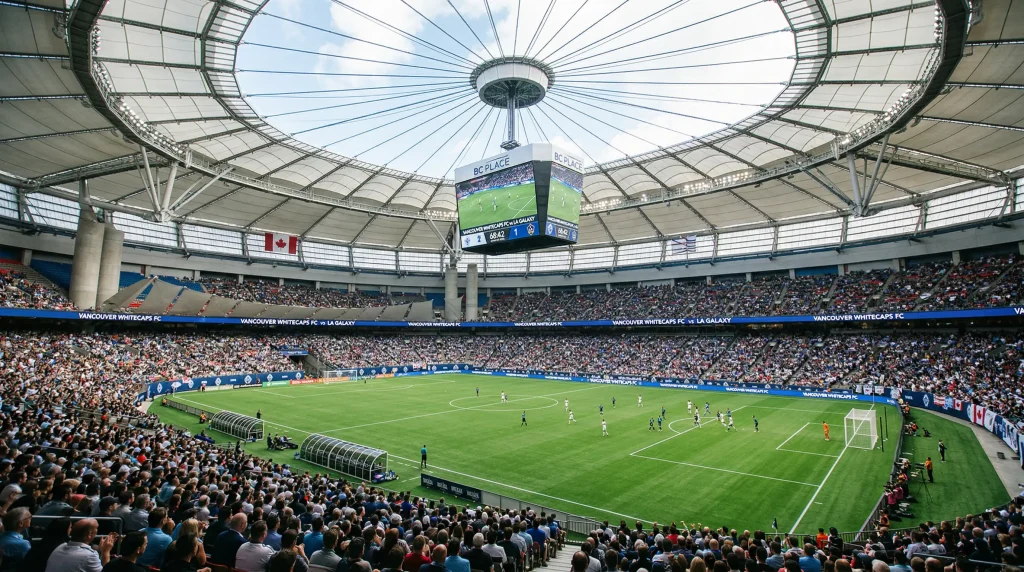
Table of Contents
Two group-stage matches plus knockout rounds — BC Place is Canada’s World Cup fortress on the Pacific. While Toronto claims the opening day honour, Vancouver might ultimately prove more consequential for Canada’s tournament fortunes. Both of Canada’s remaining group matches occur here, and if Jesse Marsch’s squad tops Group B, their Round of 32 fixture stays in this building.
I’ve covered matches at BC Place since the Whitecaps’ MLS era began in 2011, and the stadium has always punched above its weight for atmosphere. The retractable roof — replaced after the catastrophic 2007 deflation — creates an enclosed cauldron when closed, amplifying crowd noise to levels that unsettle visiting sides. For Canada’s World Cup matches, expect the roof closed regardless of weather: the acoustic advantage outweighs any ambiance benefit from open-air conditions.
BC Place — Vancouver’s Retractable-Roof Stadium
BC Place opened in 1983 as Canada’s first covered stadium, initially featuring an air-supported roof that required constant inflation. The design was revolutionary for its era but proved costly to maintain and vulnerable to weather events. The infamous 2007 deflation — when the roof collapsed under snow weight — forced a complete redesign that produced the current retractable cable-supported structure.
The stadium’s current capacity sits at 54,500 for football configuration, making it Canada’s largest indoor venue. For the World Cup, FIFA’s match requirements have reduced seating to approximately 48,000 to accommodate enhanced broadcast positions, expanded media facilities, and premium hospitality areas that FIFA’s commercial partners require. The reduction hasn’t affected regular supporter sections — the Southsiders’ end remains intact.
BC Place sits in the heart of False Creek North, a reclaimed industrial area that transformed during Vancouver’s Expo 86 world fair. The surrounding neighbourhood — now called Yaletown — has become the city’s densest residential zone, packed with restaurants, bars, and coffee shops within walking distance of the stadium. Rogers Arena (home of the Canucks) sits immediately adjacent, creating a sports district that rivals any in North America.
For international visitors, BC Place’s location is exceptionally convenient. The SkyTrain’s Stadium-Chinatown station sits directly beneath the venue, providing rapid transit connections to Vancouver International Airport (25 minutes), downtown hotels (5 minutes), and suburban accommodation in Burnaby and Surrey. The Canada Line runs every few minutes during event periods, and the capacity has been enhanced for World Cup fixtures.
The stadium’s playing surface has been converted to natural grass for the tournament. BC Place normally uses FieldTurf artificial surface — a necessity given the Lions’ CFL schedule and frequent concert bookings — but FIFA’s regulations mandate real grass for World Cup fixtures. The installation process began in March 2026, with ongoing maintenance to ensure pitch quality through the knockout rounds.
World Cup 2026 Matches at BC Place
BC Place hosts seven World Cup fixtures: three group stage matches plus four knockout round games (two Round of 32, two Round of 16). This allocation exceeds Toronto’s assignment and reflects Vancouver’s larger capacity and superior infrastructure for major international events.
June 12: Switzerland versus Qatar, 12:00 PM PT (3:00 PM ET). The same day as Canada’s Toronto opener, this Group B fixture provides context for Canada’s path. A comfortable Swiss victory — which oddsmakers expect — would leave Canada needing to match that result against Bosnia to maintain group-stage momentum.
June 18: Canada versus Qatar, 3:00 PM PT (6:00 PM ET). Canada’s second group match, played at prime time for East Coast viewers while remaining accessible for Vancouver’s workday-ending crowds. Ticket demand has been extraordinary, though slightly below the Toronto opener. Secondary market prices sit around C$600-900 for standard seating.
June 21: New Zealand versus Egypt, 3:00 PM PT. This Group G fixture brings two nations to Vancouver that rarely compete in Canadian venues. New Zealand’s Oceania federation membership means almost no competitive football occurs in North America, while Egypt’s African zone keeps them equally distant. For Canadian neutrals, this offers genuine World Cup exoticism.
June 24: Switzerland versus Canada, 12:00 PM PT (3:00 PM ET). The match that could decide Group B’s winner. If Canada beats Bosnia and Qatar in their opening two fixtures, this becomes a straight shootout for top spot. Switzerland’s tournament pedigree — quarter-finals at Euro 2024, consistent knockout qualification — makes them the sternest test of Canada’s World Cup credentials.
Canada vs Qatar and Switzerland vs Canada — The Home Games
Canada’s Vancouver fixtures carry distinct strategic implications. Against Qatar on June 18, Canada faces a weakened opponent who will likely have lost their opening match to Switzerland. The psychological burden of another disappointing World Cup performance — after Qatar’s winless 2022 campaign on home soil — could undermine the visitors before kickoff.
Jesse Marsch has indicated he views this Qatar fixture as the opportunity to secure qualification before the Switzerland match. Six points from the opening two games would guarantee advancement regardless of the group’s final fixture, allowing Canada to approach the Swiss match with freedom rather than desperation. For betting purposes, this means heavy Canadian investment in the Qatar match: Marsch will field his strongest eleven and demand relentless pressure.
The Qatar match atmosphere should be dominated by Canadian supporters. Unlike the Toronto opener — where Bosnia’s Hamilton and Kitchener communities will provide substantial away backing — Qatar has minimal diaspora presence in British Columbia. Expect 45,000+ Canadians creating the loudest atmosphere any Canada national team match has produced.
Against Switzerland on June 24, the dynamics shift. The Swiss bring genuine quality: Granit Xhaka’s midfield control, Manuel Akanji’s defensive composure, and a tournament-hardened mentality that comes from consistent knockout round appearances. Switzerland has reached at least the Round of 16 in each of the last four major tournaments — a consistency that Canada cannot claim. Their Euro 2024 quarter-final run, where they eliminated Italy before losing to England on penalties, demonstrated the composure that makes them dangerous in high-stakes fixtures.
This match likely determines whether Canada faces their Round of 32 fixture in Vancouver or travels to an American venue. Group B winners are assigned to BC Place for the knockout round, while second-place finishers enter a bracket that could send them to Seattle, Dallas, or Houston. The home advantage incentive adds stakes beyond simple pride. For Canadian supporters who’ve purchased knockout round tickets hoping to see their nation, the Switzerland match outcome directly affects whether that investment pays off.
Knockout Rounds in Vancouver — Round of 32 and 16
BC Place’s knockout allocation makes Vancouver potentially the site of Canada’s most important match. If Canada finishes first in Group B, they’ll play their Round of 32 fixture at BC Place on June 29 or 30 against a third-place team from Groups A, C, or D. A victory would advance them to a Round of 16 match — also potentially at BC Place, depending on bracket positioning.
The Round of 32 opponents from those groups could include Mexico (if they stumble), Australia, or Paraguay. None of these outcomes would represent an easy draw, but playing at home against a third-place finisher provides structural advantage that Canada must maximise.
The Round of 16 matches at BC Place (July 3-4) will feature winners of designated bracket positions. Without knowing group stage results, it’s impossible to predict specific matchups, but the bracket structure means European or South American opponents are possible. A Canada-Argentina Round of 16 match at BC Place — unlikely but theoretically possible — would constitute perhaps the most significant sporting event in Canadian history.
Ticket pricing for knockout rounds has been structured at premium levels compared to group matches. FIFA’s allocation reserves 8% of tickets for the general public, with the remainder distributed to commercial partners, national football associations, and hospitality packages. Secondary market prices for knockout fixtures at BC Place currently range from C$500 (upper deck Round of 32) to C$3,000+ (lower bowl Round of 16).
Vancouver Game Day — Getting There and Around
Vancouver’s game day experience begins long before entering BC Place. The official FIFA Fan Festival will occupy the plaza surrounding Science World, roughly a 15-minute walk from the stadium along False Creek’s seawall. This activation zone will include big screens showing other matches, sponsor experiences, and food vendors that extend World Cup atmosphere beyond the stadium confines.
For supporters attending matches, the SkyTrain Canada Line remains the optimal transport choice. Arriving at Stadium-Chinatown station places you immediately at BC Place’s entrance, avoiding the traffic congestion that will paralyse surrounding streets. From downtown Vancouver hotels, the journey takes 5-10 minutes; from the airport, approximately 25 minutes. Enhanced service frequency during match periods — trains every 3-4 minutes rather than the standard 6-8 — should accommodate demand.
Walking from downtown Yaletown hotels takes 10-20 minutes depending on specific location. The route along False Creek’s seawall offers scenery and atmosphere, with the Olympic Village neighbourhood providing pre-match dining options. Craft breweries (33 Acres, Main Street Brewing), coffee roasters (Elysian, Platform 7), and brunch spots (Fable Diner, Yolks) line the walking route for those arriving early.
Post-match celebrations will depend on results. Yaletown’s Mainland Street — essentially a restaurant row — becomes pedestrian-dominated after events, with patios extending into street space that normally accommodates traffic. The Donnelly Group pubs (Lamplighter, Railway Club, Bimini’s) scattered across downtown Vancouver will broadcast every match and serve as gathering points for supporters unable to secure stadium tickets.
Accommodation in Vancouver presents challenges similar to Toronto. The downtown core’s major hotels (Fairmont Pacific Rim, Rosewood Georgia, JW Marriott) blocked rooms for World Cup packages months ago. The Yaletown and False Creek areas offer boutique alternatives (Opus Hotel, YWCA Hotel), while budget-conscious visitors might consider Airbnb options in Mount Pleasant or East Vancouver, both accessible via transit.
For Canadian supporters following the national team from Toronto’s opener to Vancouver’s subsequent matches, flight options include multiple daily departures on Air Canada and WestJet. The route takes approximately 4.5 hours, and prices during the tournament period have risen substantially above normal levels. Booking early — ideally before group stage positions become clear — provides the best value.
